Taking a broader view of sustainability in lighting
A New Perspective on Sustainability
Traditionally, lighting sustainability focuses on energy efficiency metrics like lumens per watt, controls, and daylighting strategies. While important, they are only part of the story. A broader view of sustainability includes reliability, modularity, serviceability, and material transparency. These concepts directly impact real-world design outcomes and contribute to long-lasting lighting systems.
Rethinking Sustainability: What truly makes lighting sustainable?
Efficiency is just the starting point, not the end goal. Consider what happens after installation: serviceability, replacement parts, and matching output over time. These factors are crucial for long-term sustainability but are often overlooked. We need to look beyond consumption and consider how long a fixture lasts, how easily it can be maintained, and whether it supports the evolving needs of the space.
The Reality of Today’s Specification Process.
Lighting must support evolving demands over time, not just day-one aesthetics. Architects and designers face increasing complexity, balancing visual outcomes, meeting codes, integrating systems, navigating supply chain realities, and delivering long-term value within compressed timelines. Often one of the last systems specified, lighting is highly visible when issues arise.
A New Lens on Lighting Sustainability: The Five Pillars of Reframed Sustainability
Let’s redefine sustainability to encompass how lighting is designed, built, maintained, and evolved over time. This broader definition supports occupant health, safety, environmental responsibility, and long-term value.
Instead of focusing solely on energy performance, we introduce five key concepts that affect the full lifecycle of a lighting system: modularity, reliability and longevity, serviceability, backward compatibility, and material transparency. These elements contribute to better outcomes for both the space and its occupants.
Modularity as a Sustainable Strategy, Enabling Longevity
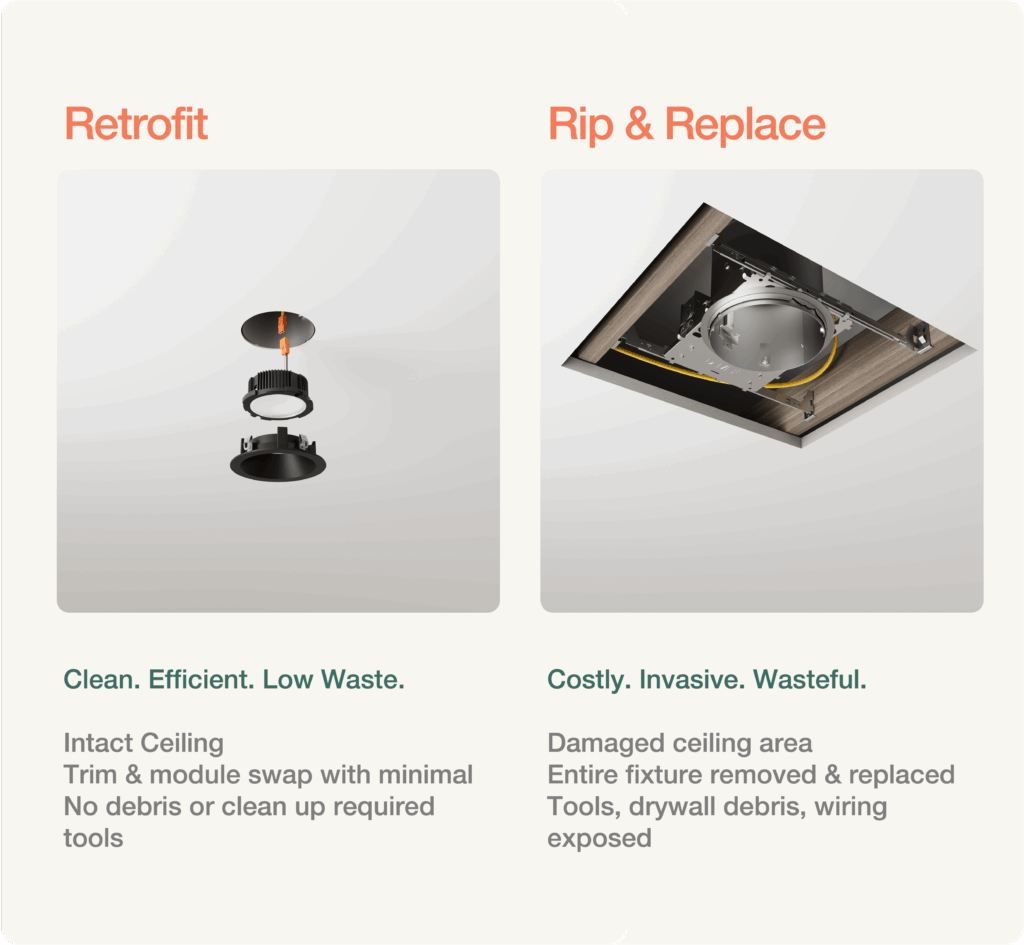
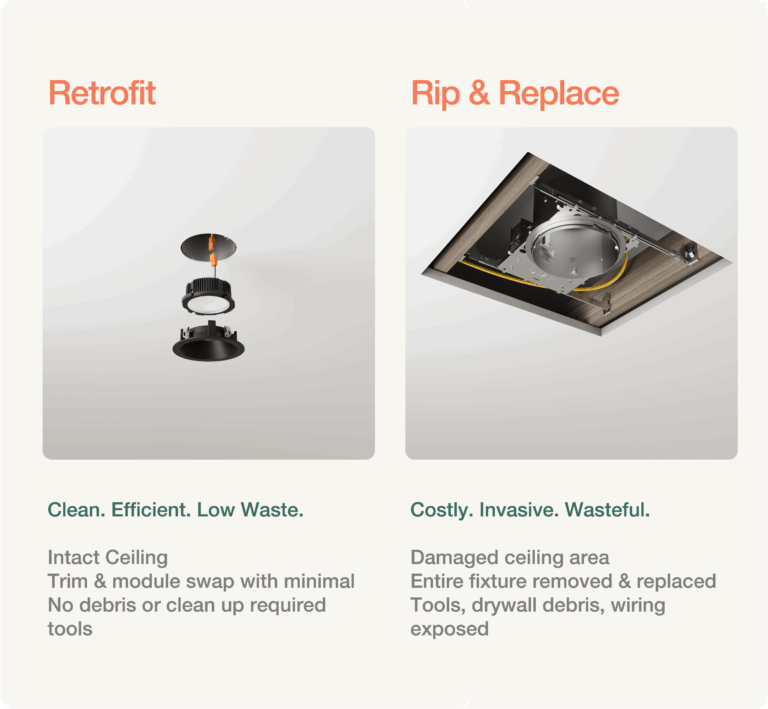
Modularity is a practical and impactful way to enhance sustainability in lighting design. Instead of replacing entire fixtures when changes or failures occur, modular systems allow individual components (like the LED module, optic, or trim) to be swapped out. This approach reduces waste, lowers costs, and minimizes disruptions to the finished space.
Modular systems also support design flexibility. A single light housing can accommodate multiple configurations, adapting to different outputs, finishes, or beam angles, even years after installation. By keeping more of the original infrastructure in place, modular systems facilitate maintenance, upgrades, and retrofits without compromising the architectural design.
Modularity in Action Example
Imagine a downlight in a finished ceiling, part of a wall wash layout in a residential or hospitality space. Years after installation, one of the lights fails. With a modular system, there’s no need to cut into the ceiling or rewire anything. The trim is removed cleanly, and the module is swapped from below. This approach saves money, minimizes disruption, and preserves the original design.

Serviceability = Sustainability
A sustainable lighting system should be maintainable, allowing components like the light module or driver to be accessed and replaced from below the ceiling without disruption. This approach minimizes waste, labor, and downtime, while maintaining design consistency.
Reliability & Longevity
Reliability isn’t just about warranty; it’s about trust in performance. Long-term sustainability depends on how well a product performs over time, not just its day-one efficiency. While many high-quality fixtures are rated for 50,000 hours of operational life, real-world performance varies based on usage conditions. For example, a fixture running 24/7 in a commercial space may only carry a 5-year warranty, whereas the same fixture in a part-time, temperature-controlled residential setting could last much longer.
When evaluating lighting systems, look beyond the spec sheet. Consider the quality of the driver, thermal design, and the manufacturer’s confidence in the product’s actual field life, not just its lab performance. The same scrutiny should apply to lighting system integration and controls compatibility.
Transparency Matters: What’s in the Fixture?
Lighting sustainability also depends on what the fixture is made of and how much you know about it. Materials like casting, adhesives, wiring, and coatings affect performance, longevity, and occupant health. For instance, some cast parts include lead to improve mold performance, certain paints and adhesives may off-gas under heat, and flame retardants in plastics are often not disclosed.
Many lighting products today are assembled through outsourced, OEM channels, making it hard to trace what’s inside. Transparency impacts long-term safety, serviceability, and compliance with health and environmental standards.
Transparency Matters: What’s in the Fixture?
Lighting sustainability also depends on what the fixture is made of and how much you know about it. Materials like casting, adhesives, wiring, and coatings affect performance, longevity, and occupant health. For instance, some cast parts include lead to improve mold performance, certain paints and adhesives may off-gas under heat, and flame retardants in plastics are often not disclosed.
Many lighting products today are assembled through outsourced, OEM channels, making it hard to trace what’s inside. Transparency impacts long-term safety, serviceability, and compliance with health and environmental standards.
Built for What’s Next: Designing Backward Compatibility
Backward compatibility ensures that today’s lighting decisions remain effective in the future. When product lines evolve or technology changes, new components should integrate seamlessly with existing installations, matching performance, beam, and output.
Without backward compatibility, even minor changes can lead to visual inconsistency or system mismatch, often necessitating broader replacements that impact budget, controls, and code compliance. Designing with this in mind allows systems to evolve without starting over, enabling easier upgrades, better long-term support, and reduced risk to design integrity over time.
Codes Are Evolving
The concepts of modularity, serviceability, and transparency are evolving from best practices to actual standards and code frameworks.
In Europe, the Ecodesign Directive will require serviceability by 2026, ensuring fixtures are accessible and repairable with standard tools. In the U.S., WELL and LEED are advocating for greater transparency, durability, and lifecycle thinking, while the IgCC is incorporating service and reuse considerations.
The trend is clear: sustainability now encompasses not just efficiency, but also the longevity, maintainability, and overall impact of fixtures.
Sustainable Systems Support People and Places
Sustainability goes beyond materials and efficiency targets; it’s about the long-term functionality and feel of a space. When lighting systems are designed for longevity, easy maintenance, and adaptability, they enhance the user experience by being consistent, seamless, and less disruptive. This is where sustainability intersects with design integrity.
Reliable systems protect visual intent, serviceable systems minimize invasive repairs, and modular systems support change without compromise.
Key Takeaways
In summary, the five concepts create the foundation for a more complete and durable view of lighting sustainability.
Five Concepts of Lighting Sustainability
- Modularity: Supports reuse, upgrades, and flexibility
- Serviceability: Protects both the ceiling and the design
- Reliability & Longevity: Reduces failure, callbacks, and long-term cost
- Transparency: Ensures safer materials and smarter sourcing
- Backward Compatibility: Allows seamless integration over time
Together, these concepts create a system built to last. Early integration of these concepts in the design process reduces risk, supports evolving needs, and delivers greater value for clients and end users.
If you are interested in learning more, DMF offers a Reframing Sustainability CEU training course. Please email training@dmflighting.com for more information.