
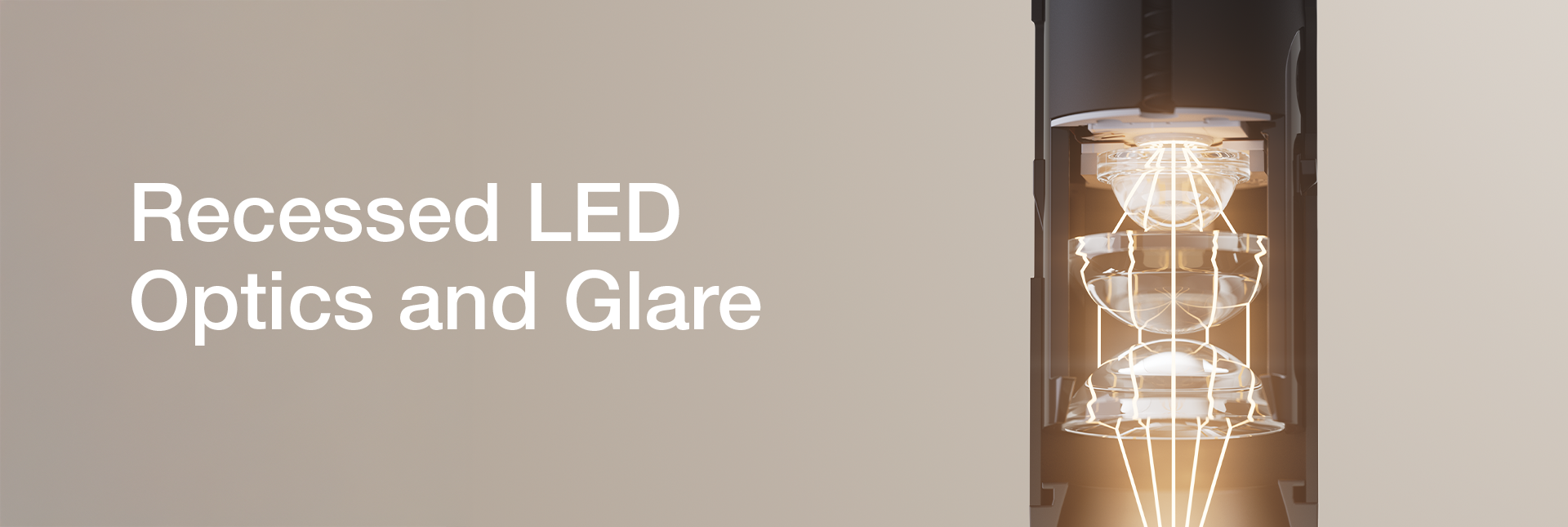
Over the past decade, architectural lighting has experienced a significant shift toward smaller and smaller luminaire apertures. Once, 4-inch and 6-inch recessed downlights dominated commercial and residential projects alike. Today, however, designers routinely specify 2-inch fixtures, and increasingly, apertures below 2 inches are becoming viable options for high-end architectural applications.
The driving force behind this trend is clear. Architects and interior designers continue to pursue cleaner ceiling planes, minimalist aesthetics and environments where lighting quietly supports the architecture rather than becoming a visual focal point. Advances in LED technology have enabled this evolution, allowing compact fixtures to deliver light output levels that would have been impossible only a few years ago.
Yet while smaller apertures create more elegant ceilings, they also introduce a fundamental challenge: glare.
As fixture apertures shrink, the same amount of light must be delivered through a much smaller opening. The result is higher luminance at the aperture and a dramatically increased potential for visual discomfort. This reality has elevated optical engineering from a secondary design consideration to one of the most critical aspects of downlight development.
Today, the success of a small-aperture downlight depends not simply on its lumen output or efficiency, but on the sophistication of the optical system behind it.
The Relationship Between Aperture Size and Glare
At first glance, it might seem intuitive that smaller fixtures would naturally be less noticeable and therefore more comfortable. In reality, the opposite can often be true.
Consider two fixtures producing the same lumen output. If one distributes that light across a large aperture and the other emits it through an aperture half the size, the smaller fixture will exhibit significantly higher luminance at its opening. To the human eye, that concentrated brightness can become distracting or even uncomfortable.
This challenge becomes especially apparent in environments where occupants spend significant amounts of time looking across a room rather than directly downward. Hospitality spaces, residences, healthcare facilities and workplaces all place occupants in positions where ceiling fixtures frequently enter their field of view.
Without careful optical control, a small aperture can appear as an intensely bright point source that attracts attention and degrades visual comfort.
The challenge for manufacturers is therefore twofold: maintain the performance expectations of modern lighting while simultaneously minimizing source visibility and glare.
Why Raw LED Output Is Not Enough
LEDs have revolutionized lighting because of their efficiency, longevity and compact size. However, the light produced directly from an LED source is rarely suitable for architectural applications.
In its natural state, an LED emits light according to what is known as a Lambertian distribution. This means light radiates broadly in nearly every direction with relatively uniform intensity.
While this characteristic may be advantageous from a manufacturing perspective, it creates several problems when incorporated into a recessed downlight.
Without optical control, light can spill into the ceiling cavity, strike fixture trims, illuminate surrounding surfaces at unintended angles and expose the bright LED source directly to room occupants. The result is wasted light, reduced efficiency and increased glare.
This is where optics become indispensable.
Optical systems transform raw LED output into useful illumination. Through carefully engineered components, designers can shape beam distributions, improve efficiency, conceal the source and create visually comfortable environments.
In many respects, optics serve as the bridge between an LED’s technical capability and the occupant’s visual experience.
Understanding Cutoff Angles
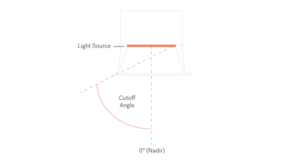
Figure 1 – A diagram showing the cutoff angle of a recessed downlight.
Among the many metrics used to evaluate downlight performance, cutoff angle is one of the most important when discussing glare.
A cutoff angle describes the point at which the light source is no longer visible to an observer. Above this angle, the optical system successfully shields the source from view. Below it, the source becomes progressively more visible.
The concept may seem simple, but its impact on visual comfort is profound.
A fixture with a narrow cutoff angle limits the number of viewing positions from which occupants can see the brightest portions of the luminaire. Consequently, the fixture appears more comfortable and less visually intrusive.
In residential living rooms, hotel guestrooms, restaurants and healthcare facilities, where occupants frequently sit or recline, narrow cutoff angles are often critical. People naturally view ceilings from shallow sightlines, increasing the likelihood of seeing directly into fixture apertures.
By contrast, in spaces with higher ceilings and more upright occupant positions, such as commercial lobbies or atriums, wider cutoff angles may be acceptable.
As apertures continue shrinking, achieving meaningful cutoff becomes increasingly difficult because there is less physical space available to shield the source. This challenge places greater importance on sophisticated optical design.
Reflectors: The Foundation of Downlight Optics
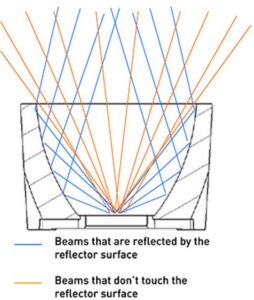
Figure 2 – An example of light beams that escape a reflector without hitting a surface, causing unwanted glare.
Reflectors represent one of the oldest and most familiar forms of optical control in lighting.
The principle is straightforward. Light emitted from the LED source strikes a reflective surface and is redirected toward the intended target area. By adjusting the shape and depth of the reflector, designers can create narrow, medium or wide beam distributions.
Reflectors offer several advantages. They can be highly efficient, produce attractive beam patterns and naturally contribute to glare control by physically recessing the light source.
For decades, deep reflector geometries formed the foundation of architectural downlighting.
However, reflector systems face increasing limitations as apertures shrink.
Effective reflector designs require physical depth. As fixtures become smaller and ceiling plenums become more constrained, the available space for meaningful reflector geometry diminishes. Reflectors also introduce optical losses through absorption and can struggle to capture very wide-angle rays emitted by LED sources.
While reflectors remain important, they are often no longer sufficient on their own for modern small-aperture fixtures.
Refractive Optics and the Rise of Precision Beam Control
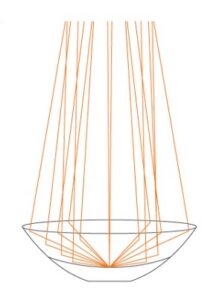
Figure 3 – A diagram of a TIR optic, which concentrates light to a tight narrow beam.
Refractive lenses provide another powerful approach to optical control.
Unlike reflectors, which redirect light through reflection, refractive optics bend light as it passes through materials with different refractive indices. This allows designers to manipulate ray trajectories with exceptional precision.
Among the most common examples are Total Internal Reflection (TIR) lenses. These optics combine refractive and reflective properties within a single element, capturing a large percentage of LED output and directing it into highly controlled beam patterns.
TIR lenses have become especially valuable in compact architectural fixtures because they can deliver precise beam control without requiring deep housings.
The benefits are significant:
- High optical efficiency
- Consistent beam patterns
- Excellent intensity control
- Compact form factors
For applications such as museums, retail environments, galleries and accent lighting, refractive optics often provide performance that traditional reflectors cannot match.
However, they also introduce challenges. Refractive optics can reveal imperfections in the LED source and may create visible color separation or hotspots if not carefully designed. As a result, they are frequently combined with secondary optical elements that soften and homogenize the beam.
The Role of Microstructure Optical Films
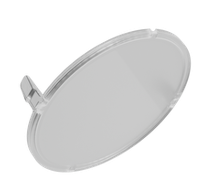
Figure 4 – DMF’s 4-inch downlights utilize microstructure lenses places in front of TIR lenses for final shaping and beam spread.
As fixture dimensions continue shrinking, optical designers increasingly rely on technologies that occupy very little physical space.
Microstructure optical films represent one of the most effective solutions.
These films contain microscopic patterns engineered to redirect, diffuse or homogenize light. Although nearly invisible to the naked eye, these structures can significantly influence beam characteristics.
Placed near the aperture plane, microstructure films often serve as the final stage of beam refinement. They can soften harsh beam edges, eliminate source imaging and create a more uniform luminous appearance.
Their thin profile makes them especially attractive for low-profile fixtures where conventional optics may not fit.
Microstructure films also play an important role in reducing visual distractions such as LED imaging, hotspots and phosphor inconsistencies.
The challenge is that diffusion inherently introduces some efficiency loss. Excessive diffusion can also undo the beam-shaping work performed by upstream optics.
Consequently, successful implementations require a careful balance between beam control, efficiency and visual comfort.
Cross Beam Optics and Modern Glare Reduction
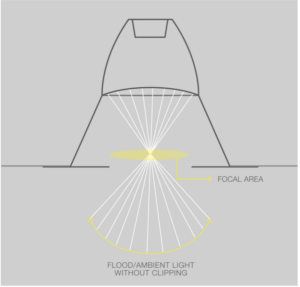
Figure 5- An example of a regressed TIR cross beam optic and the effect on rays of light, utilized in DMF’s 3-inch downlights.
One of the most significant advances in contemporary downlight design is the development of cross beam optical systems.
Cross beam optics seek to solve a common problem in recessed lighting: stray light striking fixture trims and surrounding surfaces.
In traditional systems, some light rays escape at shallow angles and illuminate the trim ring or aperture edge. This creates bright halos around fixtures that draw attention to the luminaire itself.
Cross beam systems redirect those peripheral rays inward, causing them to converge before exiting the fixture.
The benefits are substantial:
- Reduced trim brightness
- Less ceiling splash
- Lower perceived glare
- Cleaner ceiling appearance
- Improved visual comfort
Perhaps most importantly, cross beam optics help fixtures visually disappear into the architecture. Rather than becoming bright points on the ceiling plane, they allow attention to remain focused on the illuminated environment itself.
As aperture sizes continue shrinking, cross beam approaches are becoming increasingly important.
Scattering vs. Non-Scattering Optics
Modern optical systems can generally be categorized as either scattering or non-scattering.
Scattering optics deliberately introduce controlled randomness into light paths. Diffusers, frosted lenses and many microstructure films fall into this category.
Their primary advantage is visual smoothness. They soften beams, eliminate hotspots and conceal source details.
However, scattering comes with tradeoffs. Light becomes less predictable, beam edges become less defined and some optical efficiency is inevitably lost.
Non-scattering optics operate differently.
Specular reflectors, polished lenses and precision optical elements preserve ray directionality and redirect light through deterministic optical principles. The resulting beams are highly controlled and efficient.
These systems excel when precise beam shaping, hard cutoffs and maximum intensity concentration are required.
The downside is that non-scattering optics faithfully reproduce source characteristics. Any non-uniformities within the LED source may become visible within the beam pattern.
Most advanced architectural fixtures therefore employ a carefully balanced combination of both approaches.
The Future of Ultra-Small Aperture Downlighting
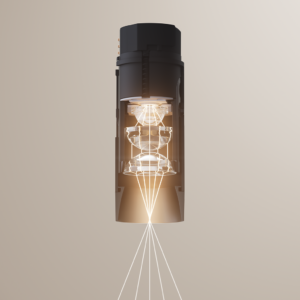
Figure 6 – DMF’s True 1 optical stack and resulting cross beam focus
As the industry continues moving toward apertures of 1 inch and below, optical design will become even more critical.
In these ultra-small formats, every stray ray matters. Even minor amounts of trim illumination can dramatically increase perceived glare. Traditional combinations of reflectors, lenses and diffusion elements often struggle to provide sufficient control within such limited physical space.
This challenge is driving a new generation of optical innovation.
For example, DMF’s True 1 downlight utilizes a patent-pending optical stack that combines multiple non-scattering optical elements with a final microstructure layer. The design creates a true cross beam focus while minimizing spill light and reducing source visibility.
The result is a soft, visually comfortable beam, exceptional glare control and a narrow cutoff angle that would be difficult to achieve using conventional optical approaches alone.
The Bottom Line
The trend toward smaller apertures shows no signs of slowing. Architects and designers continue to seek cleaner ceilings, more discreet fixtures and lighting systems that quietly complement the built environment.
But miniaturization alone does not create better lighting.
As apertures shrink, optics become increasingly responsible for determining whether a fixture delivers visual comfort or visual distraction. Reflectors, refractive lenses, microstructure films and cross beam technologies all play important roles in shaping the modern lighting experience.
Ultimately, the best small-aperture downlights are not simply miniature fixtures. They are highly engineered optical systems designed to balance efficiency, beam control, glare reduction and occupant comfort.
In the pursuit of visually quiet ceilings, optics have become the true differentiator.
For more in-depth information, read the Recessed LED Optics and Glare Technical Bulletin