August 6, 2026

Easy Maintenance, Built In: The DMF Approach to Lighting That Just Works

Discover how DMF’s modular lighting systems simplify maintenance, reduce lifecycle costs and enable fast, below-ceiling serviceability.
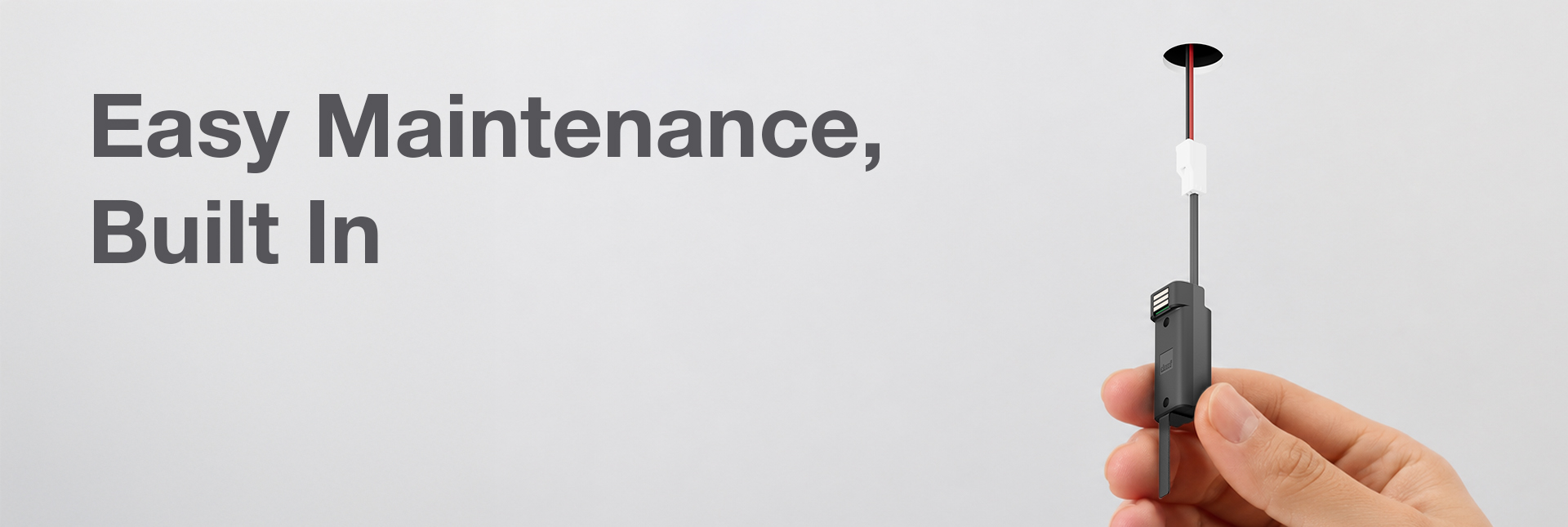
Hand holding a DMF Lighting modular LED light engine module below the ceiling, illustrating easy, below-ceiling maintenance and replacement.

In most lighting systems, maintenance is treated as an unavoidable inconvenience  addressed only after a fixture fails or technology becomes outdated. But for contractors, facility managers and building owners, the consequences of poor serviceability extend far beyond a simple repair.

Traditional lighting maintenance often involves accessing ceiling plenums, coordinating multiple trades, disrupting occupied spaces and replacing entire fixtures because a single component has failed. What should be a routine service call can quickly become an expensive, time-consuming process involving downtime, ceiling damage and rising labor costs.

As LED technology matures and buildings operate longer, those challenges are becoming harder to ignore. Today, lighting systems are increasingly evaluated not only on aesthetics and performance, but also on how easily they can be maintained, upgraded and adapted over time.

At DMF Lighting, maintenance is engineered into the product from the very beginning. The company’s modular approach creates lighting systems that are easier to service, simpler to upgrade and designed to evolve alongside the spaces they illuminate.


Modular Lighting Systems for Easier Maintenance

DMF’s modular lighting system architecture centers around three key components: the housing, the LED light engine module and the trim. That separation fundamentally changes the way architectural lighting maintenance is performed.

Because the driver is integrated directly into the LED module – versus remotely – servicing no longer requires accessing the ceiling plenum or working with complex wiring. Instead, modules can be replaced from below the ceiling in just minutes.

No tools. No ceiling disruption. No unnecessary fixture replacement.

This approach creates immediate operational advantages across a wide range of environments.

For facility managers, maintenance becomes faster and less disruptive. Instead of coordinating ceiling access or scheduling invasive repairs, teams can perform quick module replacements with minimal interruption to daily operations.

For contractors and electricians, independently serviceable components simplify troubleshooting and reduce service time. And for owners, modularity helps lower LED lighting lifecycle cost by extending the usable life of the installed system by reusing the housing and wiring.

Rather than treating fixtures as disposable products, DMF designs lighting systems to adapt over time.


Tool-Free Lighting Maintenance for Faster Serviceability

One of the defining advantages of DMF’s design philosophy is tool-less lighting serviceability.

Many traditional fixtures require specialized tools, fixture disassembly or above-ceiling access for even routine servicing. In occupied environments such as hotels, offices, healthcare facilities and multifamily properties, that disruption can create operational and logistical challenges.

DMF eliminates many of those barriers through touch-safe, plug-and-play modules engineered for replacement from below the ceiling.

This simplifies maintenance by allowing technicians to quickly restore lighting without removing fixtures or opening ceilings.

The benefits include:

  • Faster maintenance cycles
  • Reduced labor requirements
  • Minimal disruption to occupied spaces
  • Simplified servicing procedures
  • Lower long-term maintenance costs

The impact becomes especially valuable in active spaces where downtime matters.

In hotels for example, maintenance can often be completed quickly and discreetly without interrupting guests or having property managers take guest rooms out of service, which can impact revenue. In healthcare environments, simplified servicing helps minimize disruption in sensitive patient areas. Multifamily properties benefit from faster turnover maintenance and fewer interruptions for residents.

These are practical lighting maintenance solutions designed around the realities of building operations.


Reducing Lifecycle Costs Through Smarter Design

The true cost of a lighting system extends far beyond the initial fixture price.

Over time, maintenance labor, replacement materials, operational downtime and repair-related disruption often become the largest expenses associated with traditional lighting systems. DMF’s modular platform was designed to reduce those long-term burdens.

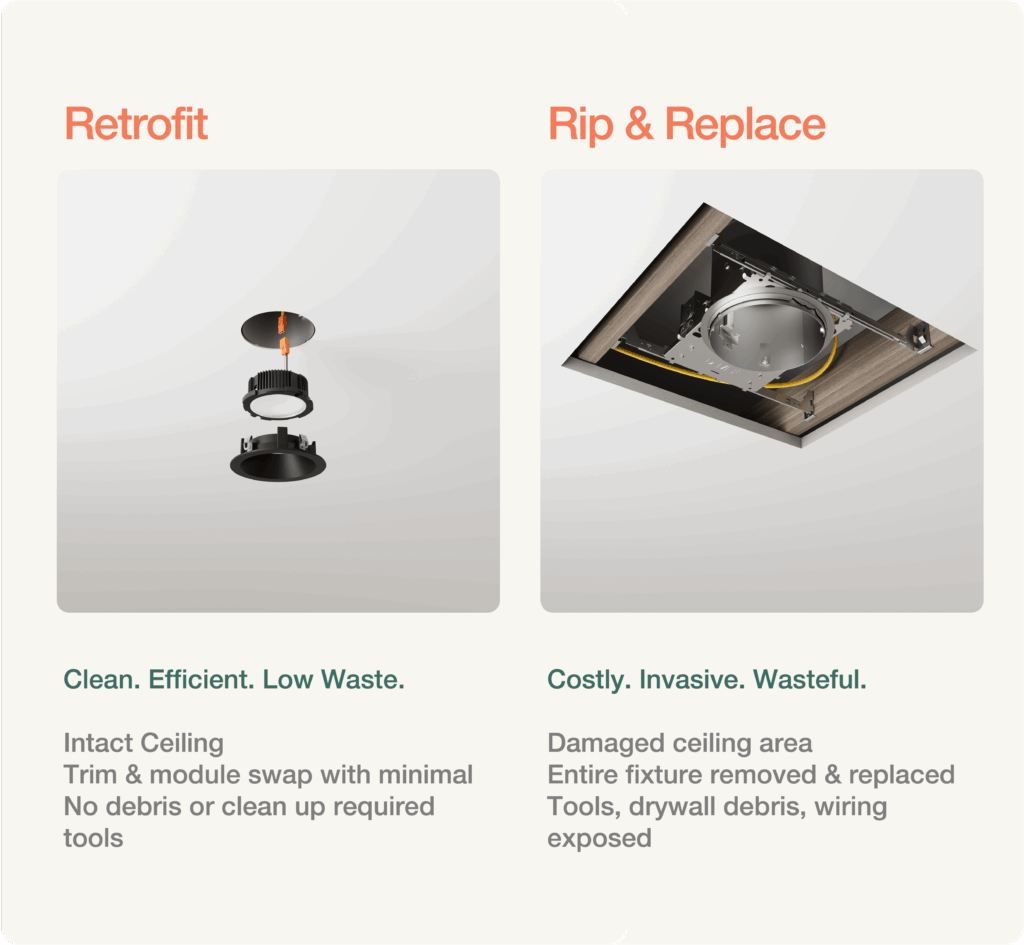
Because individual modules can be serviced independently, building owners avoid replacing entire fixtures when maintenance is required. That distinction reduces labor demands, minimizes waste and extends the life of installed infrastructure.

For large commercial properties or multifamily developments, these efficiencies compound significantly over time.

Maintenance teams can complete repairs faster, while owners benefit from reduced operational disruption and more predictable long-term maintenance planning. In retail and office environments, faster serviceability also helps maintain continuity within occupied spaces.

By simplifying maintenance at the component level, DMF helps reduce total LED lighting lifecycle cost while improving overall operational efficiency.


Future-Proof Lighting Systems Built for Upgrades

Modern lighting systems must do more than perform well today — they must remain adaptable for years to come.

Many conventional fixtures become outdated long before the building itself does, often requiring complete replacement when technology evolves. DMF’s modular platform addresses this challenge through lighting upgrade systems designed for long-term flexibility.

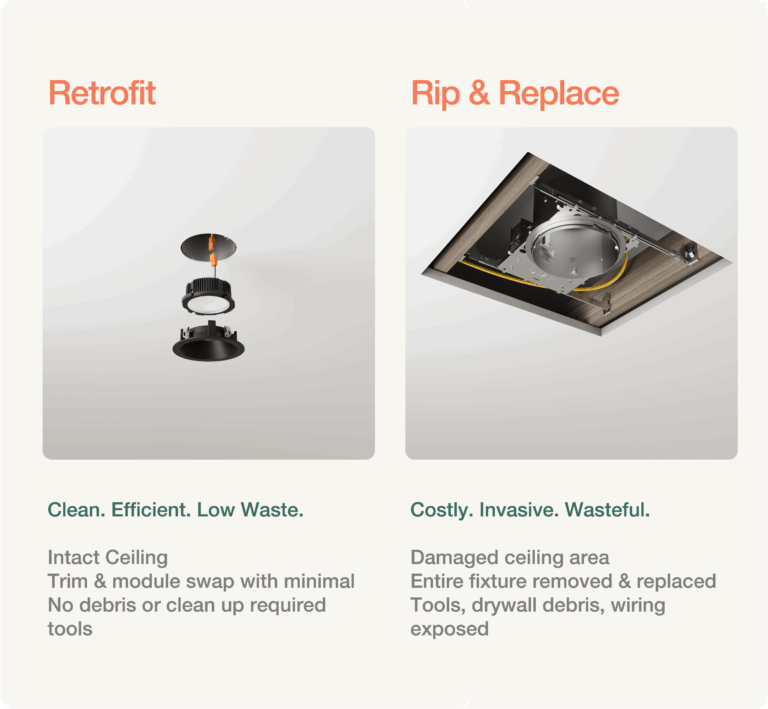
Because the LED modules can be independently replaced, buildings gain the ability to evolve lighting systems without extensive demolition or full fixture replacement.

This approach supports:

  • Simplified upgrades over time
  • Easier adaptation to evolving technologies
  • Reduced waste through component-level replacement
  • Greater flexibility for future renovations

Rather than locking buildings into static technology, DMF designs systems that can evolve alongside changing project needs. The same philosophy extends to retrofit solutions, helping preserve existing infrastructure while reducing demolition, material waste and the costs associated with replacing entire lighting systems.


Designed Around Real-World Challenges

DMF’s engineering philosophy is rooted in solving practical field challenges before they become operational problems.

Innovations such as embedded driver technology, modular quick-connect systems, interchangeable optics and modular platforms are all designed to simplify installation, servicing and long-term ownership.

This benefits every stakeholder involved:

  • Facility managers gain easier maintenance workflows
  • Contractors reduce service complexity and callbacks
  • Owners benefit from lower operational costs and longer system lifespan

By focusing on real-world usability, DMF transforms maintenance from a recurring frustration into a streamlined process.


Continuous Improvement Through Customer Feedback

DMF’s emphasis on serviceability is reinforced through ongoing collaboration with designers, contractors, facility teams and customers.

The company continuously gathers Voice of Customer (VOC) feedback to better understand how products perform in real-world environments and how maintenance processes can be further improved.

That feedback helps DMF:

  • Refine products based on field experience
  • Improve maintenance workflows
  • Adapt designs to evolving project needs
  • Ensure long-term product relevance and serviceability

This process keeps product development closely aligned with the practical realities of installation and maintenance.


Built to Last, Designed to Be Trusted

The best maintenance strategy starts with reliable products.

DMF systems are engineered to rigorous quality standards that support long-term performance and predictable operation. The company’s emphasis on durability and serviceability helps reduce failures while simplifying maintenance when service is eventually required.

The philosophy is simple: it just works.

And when maintenance is needed, the process is fast, straightforward and minimally disruptive.


A Smarter Investment in the Future

As a family-owned company, DMF prioritizes long-term innovation over short-term gains. That independence allows the company to continually invest in engineering solutions focused on serviceability, adaptability and long-term value.

This commitment drives the development of:

  • Modular lighting systems
  • Tool-less lighting serviceability
  • Sustainable upgrade paths
  • Long-term architectural lighting maintenance solutions

Rather than designing products around replacement cycles, DMF creates systems intended to evolve over time — helping reduce waste, lower maintenance costs and extend system lifespan.


The Bottom Line

Easy maintenance is not simply a feature at DMF Lighting. It is a design philosophy integrated into every product from the start.

Through modular lighting systems, simplified serviceability and future-ready upgrade platforms, DMF transforms maintenance from a recurring burden into a long-term operational advantage.

Because when lighting is designed to evolve, everything else becomes simpler.

Maintenance and serviceability information for DMF products is conveniently featured on the front page of each product specification sheet and further supported through detailed installation videos.
November 17, 2025

Reframing Sustainability CEU

Taking a broader view of sustainability in lighting

A New Perspective on Sustainability

Traditionally, lighting sustainability focuses on energy efficiency metrics like lumens per watt, controls, and daylighting strategies. While important, they are only part of the story. A broader view of sustainability includes reliability, modularity, serviceability, and material transparency. These concepts directly impact real-world design outcomes and contribute to long-lasting lighting systems.


Rethinking Sustainability: What truly makes lighting sustainable?

Efficiency is just the starting point, not the end goal. Consider what happens after installation: serviceability, replacement parts, and matching output over time. These factors are crucial for long-term sustainability but are often overlooked. We need to look beyond consumption and consider how long a fixture lasts, how easily it can be maintained, and whether it supports the evolving needs of the space.

The Reality of Today’s Specification Process.

Lighting must support evolving demands over time, not just day-one aesthetics. Architects and designers face increasing complexity, balancing visual outcomes, meeting codes, integrating systems, navigating supply chain realities, and delivering long-term value within compressed timelines. Often one of the last systems specified, lighting is highly visible when issues arise.

Sustainability is not isolated; decisions about lighting are influenced by budget, performance expectations, aesthetics, and future service needs. These constraints shape possibilities. It’s time to redefine sustainability, considering the total experience over time, not just consumption.

A New Lens on Lighting Sustainability: The Five Pillars of Reframed Sustainability

Let’s redefine sustainability to encompass how lighting is designed, built, maintained, and evolved over time. This broader definition supports occupant health, safety, environmental responsibility, and long-term value.


Instead of focusing solely on energy performance, we introduce five key concepts that affect the full lifecycle of a lighting system: modularity, reliability and longevity, serviceability, backward compatibility, and material transparency. These elements contribute to better outcomes for both the space and its occupants.

Modularity as a Sustainable Strategy, Enabling Longevity

Modularity is a practical and impactful way to enhance sustainability in lighting design. Instead of replacing entire fixtures when changes or failures occur, modular systems allow individual components (like the LED module, optic, or trim) to be swapped out. This approach reduces waste, lowers costs, and minimizes disruptions to the finished space.


Modular systems also support design flexibility. A single light housing can accommodate multiple configurations, adapting to different outputs, finishes, or beam angles, even years after installation. By keeping more of the original infrastructure in place, modular systems facilitate maintenance, upgrades, and retrofits without compromising the architectural design.

Modularity in Action Example                                                     

Imagine a downlight in a finished ceiling, part of a wall wash layout in a residential or hospitality space. Years after installation, one of the lights fails. With a modular system, there’s no need to cut into the ceiling or rewire anything. The trim is removed cleanly, and the module is swapped from below. This approach saves money, minimizes disruption, and preserves the original design.


Serviceability = Sustainability

A sustainable lighting system should be maintainable, allowing components like the light module or driver to be accessed and replaced from below the ceiling without disruption. This approach minimizes waste, labor, and downtime, while maintaining design consistency.

Reliability & Longevity

Reliability isn’t just about warranty; it’s about trust in performance. Long-term sustainability depends on how well a product performs over time, not just its day-one efficiency. While many high-quality fixtures are rated for 50,000 hours of operational life, real-world performance varies based on usage conditions. For example, a fixture running 24/7 in a commercial space may only carry a 5-year warranty, whereas the same fixture in a part-time, temperature-controlled residential setting could last much longer.


When evaluating lighting systems, look beyond the spec sheet. Consider the quality of the driver, thermal design, and the manufacturer’s confidence in the product’s actual field life, not just its lab performance. The same scrutiny should apply to lighting system integration and controls compatibility.

Transparency Matters: What’s in the Fixture?

Lighting sustainability also depends on what the fixture is made of and how much you know about it. Materials like casting, adhesives, wiring, and coatings affect performance, longevity, and occupant health. For instance, some cast parts include lead to improve mold performance, certain paints and adhesives may off-gas under heat, and flame retardants in plastics are often not disclosed.  


Many lighting products today are assembled through outsourced, OEM channels, making it hard to trace what’s inside. Transparency impacts long-term safety, serviceability, and compliance with health and environmental standards.

Transparency Matters: What’s in the Fixture?

Lighting sustainability also depends on what the fixture is made of and how much you know about it. Materials like casting, adhesives, wiring, and coatings affect performance, longevity, and occupant health. For instance, some cast parts include lead to improve mold performance, certain paints and adhesives may off-gas under heat, and flame retardants in plastics are often not disclosed. 


Many lighting products today are assembled through outsourced, OEM channels, making it hard to trace what’s inside. Transparency impacts long-term safety, serviceability, and compliance with health and environmental standards.

Built for What’s Next: Designing Backward Compatibility

Backward compatibility ensures that today’s lighting decisions remain effective in the future. When product lines evolve or technology changes, new components should integrate seamlessly with existing installations, matching performance, beam, and output.


Without backward compatibility, even minor changes can lead to visual inconsistency or system mismatch, often necessitating broader replacements that impact budget, controls, and code compliance. Designing with this in mind allows systems to evolve without starting over, enabling easier upgrades, better long-term support, and reduced risk to design integrity over time.

Codes Are Evolving

The concepts of modularity, serviceability, and transparency are evolving from best practices to actual standards and code frameworks.


In Europe, the Ecodesign Directive will require serviceability by 2026, ensuring fixtures are accessible and repairable with standard tools. In the U.S., WELL and LEED are advocating for greater transparency, durability, and lifecycle thinking, while the IgCC is incorporating service and reuse considerations.


The trend is clear: sustainability now encompasses not just efficiency, but also the longevity, maintainability, and overall impact of fixtures.

Sustainable Systems Support People and Places

Sustainability goes beyond materials and efficiency targets; it’s about the long-term functionality and feel of a space. When lighting systems are designed for longevity, easy maintenance, and adaptability, they enhance the user experience by being consistent, seamless, and less disruptive. This is where sustainability intersects with design integrity.

Reliable systems protect visual intent, serviceable systems minimize invasive repairs, and modular systems support change without compromise.

Key Takeaways

In summary, the five concepts create the foundation for a more complete and durable view of lighting sustainability.


Five Concepts of Lighting Sustainability

  • Modularity: Supports reuse, upgrades, and flexibility
  • Serviceability: Protects both the ceiling and the design
  • Reliability & Longevity: Reduces failure, callbacks, and long-term cost
  • Transparency: Ensures safer materials and smarter sourcing
  • Backward Compatibility: Allows seamless integration over time

Together, these concepts create a system built to last. Early integration of these concepts in the design process reduces risk, supports evolving needs, and delivers greater value for clients and end users.


If you are interested in learning more, DMF offers a Reframing Sustainability CEU training course. Please email training@dmflighting.com for more information.

April 22, 2024

DMF’s Commitment to Sustainability


Shining a light on sustainability

DMF is dedicated to saving our earth through eco-friendly practices, including energy-efficient design, recycled materials usage, waste reduction strategies, and a post-warranty refurbishment program.

Designed to the Most Rigorous Standards

Energy Efficiency – Based in California, all our products are LED and designed around the most stringent local mandates and energy codes, like Title 24 ensuring optimum energy efficiency.


Declare Listed, Red List Compliant Since 2020 – DMF was one of the first downlighting manufacturers to become Declare Listed and today all product SKUs proudly carry the Declare Label.


Sustainably Designed – We continue to be at the forefront of sustainable design.  Universal, junction box-based housings are designed free of electronics ensuring a future-proof solution.

Manufactured for Optimum Performance

Non-Waste Sheet Metal – By design, all of our sheet metal punch outs and excess scrap metal are utilized for smaller components minimizing waste and cost.


Alternative Material Sourcing – Our H Series housings are manufactured in the United States out of PET plastic making them not only recyclable but incredibly lightweight, providing for more efficient transport.


20% Aluminum Reuse Policy – 20% of the diecast aluminum parts used in our light fixtures are recycled to provide a sustainable footprint while at the same time ensuring we are not sacrificing the integrity of the material or performance.

Filling Orders, not Landfills

Recyclable Packaging – All DMF packaging is made of recyclable cardboard and additionally, any used packaging we receive is shredded and repurposed as filling for future packages.


Bulk Packaging – Available upon request to help you minimize job site waste.

End of Life & Long-Term Maintenance Commitment

90% Recyclable Components – All metal, steel & plastic components in our product are recyclable, additionally DMF will recycle your retired electronics free of charge if you send them back to our factory.


Post Warranty Refurbishment Program – Housings from our product can be reused to update spaces sustainably with little labor impact.  You can be confident there will be new products that will support your upgrades for years to come. DMF is committing to circular product solutions, ensuring you have a solution for your fixture when it reaches the end of its life.  For any product sold from 2024 and on, DMF’s refurbishment program will rework or offer a backwards compatible product 5 years after warranty to give you the most sustainable solution.