
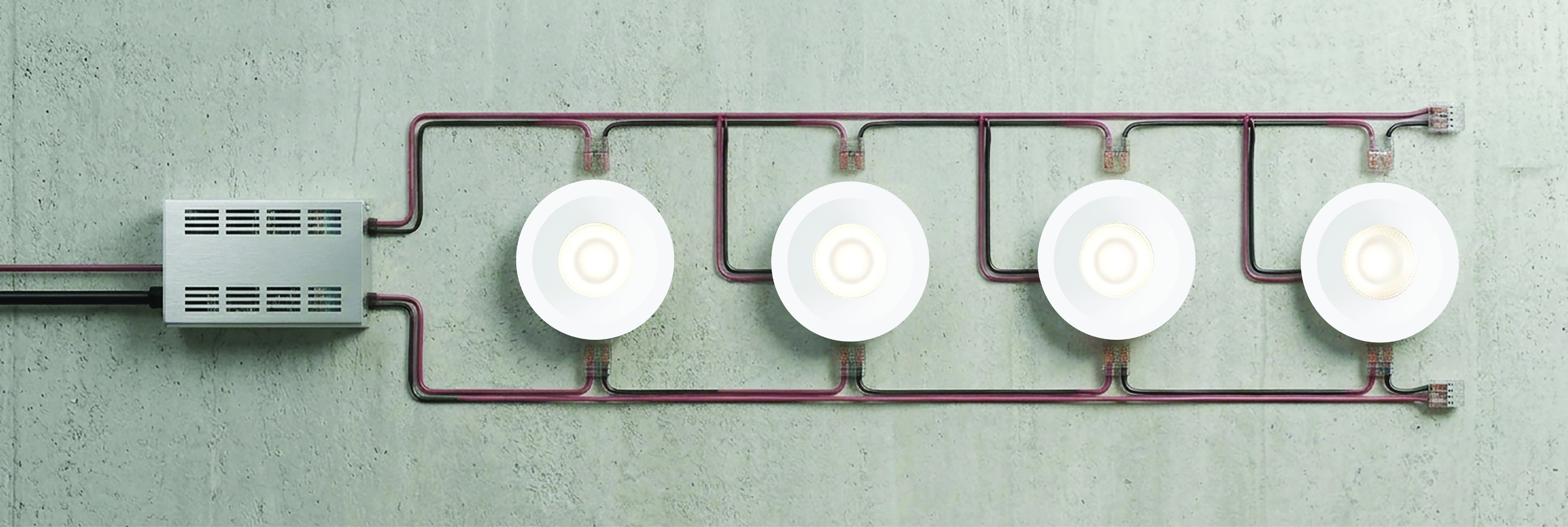
When specifying low-voltage LED lighting, the conversation often focuses on lumen output, color temperature, optics, aperture size, and dimming performance. But there is another design consideration that can have a significant impact on how a system performs in the field: how the fixtures are connected to the driver.
For installations using multiple point-source LED fixtures, the choice of wiring topology can affect everything from voltage requirements and fixture-to-fixture consistency to troubleshooting and future flexibility.
Traditionally, designers and installers working with multiple LED fixtures powered by a single constant-current (CC) driver have had two primary options: wiring the fixtures in series or in parallel. Each approach has advantages, but each also introduces considerations that can complicate system design.
A third approach—using a constant-voltage source with independent current regulation inside each fixture—offers another way to think about low-voltage LED system design.
Series Wiring: Consistent Current, Limited Flexibility
In a series configuration, multiple LED fixtures are connected along a single electrical path. The same regulated current passes through every fixture in the chain.
That provides one inherent advantage: each fixture receives the same drive current, which helps promote consistent light output across the installation.
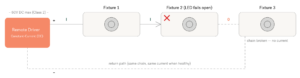
The tradeoff is that the voltage requirements of each fixture are cumulative. As fixtures are added, their individual forward-voltage requirements add together. For a Class 2 circuit, the DC voltage limit is 60V, so the total voltage of the LED load must remain within the applicable circuit and driver limits.
This can place practical limits on the number of fixtures that can be connected in a series string.
Series wiring also creates a single electrical path through the entire run. If an open circuit occurs in one fixture, current to the rest of the string will be interrupted, causing the other fixtures to turn off as well, which can complicate troubleshooting.
And because adding or removing a fixture changes the total voltage required by the string, field modifications can cause the circuit to fall outside of the operating range of the driver.
For applications where fixture quantity or configuration may change, those limitations can become particularly important.
Parallel Wiring: Simpler Distribution, More Complex Current Management
Parallel wiring takes a different approach. Instead of forming one continuous electrical path, each fixture connects across the driver’s output.
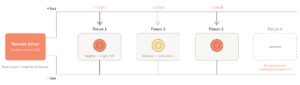
This can simplify the physical distribution of power and eliminates the single-path failure mode associated with a series string. However, when multiple LED loads are connected directly to a conventional CC driver, managing current between those loads becomes an important consideration.
LEDs are inherently nonlinear electrical loads. Even LEDs that are closely matched can have differences in forward voltage. When LED loads are connected in parallel without independent current regulation or appropriate current-balancing circuitry, those differences can result in uneven current distribution.
This can result can be noticeable variations in light output between fixtures that are intended to look identical.
There is another consideration: changes to the connected load can affect how the driver’s regulated current is distributed. Removing a fixture or opening a branch can change the electrical conditions experienced by the remaining loads. Without independent current regulation or appropriate current limiting, the remaining fixtures may be subjected to higher-than-intended current, potentially affecting long-term reliability.
The driver also has to be configured around the combined requirements of the connected fixtures. As fixture quantities change, the driver configuration may need to change with them.
So while parallel wiring addresses some of the limitations of series wiring, it introduces another challenge: how to ensure that each fixture receives the current it actually needs.
A Different Approach: Put Current Regulation Where It Matters
What if each fixture could regulate its own LED current?
That is the principle behind DMF Lighting’s approach with SpectraDrive™ DC-to-DC regulation.
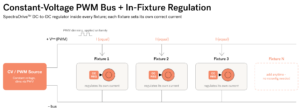
Rather than relying on a remote CC driver to regulate the combined LED load, each DMF True 1 downlight incorporates its own SpectraDrive™ DC-to-DC regulator to regulate LED current locally. The system is powered by a constant-voltage Pulse Width Modulation (PWM) source, with the fixtures connected in parallel across the supply.
In this architecture, each fixture independently regulates its LED current. As a result, normal differences in LED forward voltage between fixtures do not determine how current is distributed across the system.
The result is a system that combines the straightforward distribution of a parallel architecture with independent current regulation at each fixture.
And that distinction can make a meaningful difference in how the system is specified, installed, and serviced.
What Does In-Fixture Current Regulation Mean for the Designer?
The benefits aren’t limited to the electrical design. Moving current regulation into each fixture can simplify several aspects of the project.
Simpler system design
With fixtures connected in parallel across a common constant-voltage bus, designers and installers don’t need to calculate cumulative LED voltages for a series string or match a remote CC output to the combined current requirements of multiple fixtures.
The True 1 downlight family can operate with a single driver configuration accommodating one to five fixtures in a plug-and-play installation.
Consistent light output
Because each fixture regulates its own LED current, light output is not dependent on the number of fixtures sharing the bus or on normal variations in LED forward voltage.
For designers, that can help create more predictable fixture-to-fixture performance across an installation.
Greater flexibility when projects change
Real-world projects rarely remain completely static.
Fixture quantities can change during installation. A fixture may need to be removed for service. A layout may be modified. A future renovation may require a different configuration.
With in-fixture current regulation, adding, removing, or servicing a fixture does not inherently change the regulated LED current of the other fixtures, provided the system remains within its rated capacity and operating limits.
Uniform dimming
The constant-voltage bus uses PWM control to provide the dimming signal to the fixtures. Because each fixture receives the same control signal, the fixtures can respond consistently across the installation.
For applications where multiple fixtures need to dim together, this coordinated response can help maintain a uniform lighting experience.
Designing for What Happens After Installation
Lighting systems are often evaluated based on how they perform when they are first installed. But the more important test may be what happens months or years later.
Fixtures need to be serviced. Layouts can change. Components may be replaced. Projects may expand or be renovated.
That makes the architecture behind a lighting system just as important as the fixture itself.
By moving LED current regulation into each fixture and powering the system from a constant-voltage PWM source, DMF’s low-voltage architecture is designed to simplify the relationship between the driver and the fixtures.
The result is a system that combines the straightforward wiring of a parallel configuration with controlled current regulation at each fixture—helping deliver simplified specification, installation, and service, with consistent performance and greater flexibility as project requirements evolve.
simplified specification, installation, and service, with consistent performance and greater flexibility
For lighting designers, contractors, and other professionals responsible for specifying and installing low-voltage LED systems, understanding the wiring topology is more than an electrical detail. It is an important part of designing a lighting system for reliable performance today—and flexibility tomorrow.