Author: Sam Orzel
What is CRI?
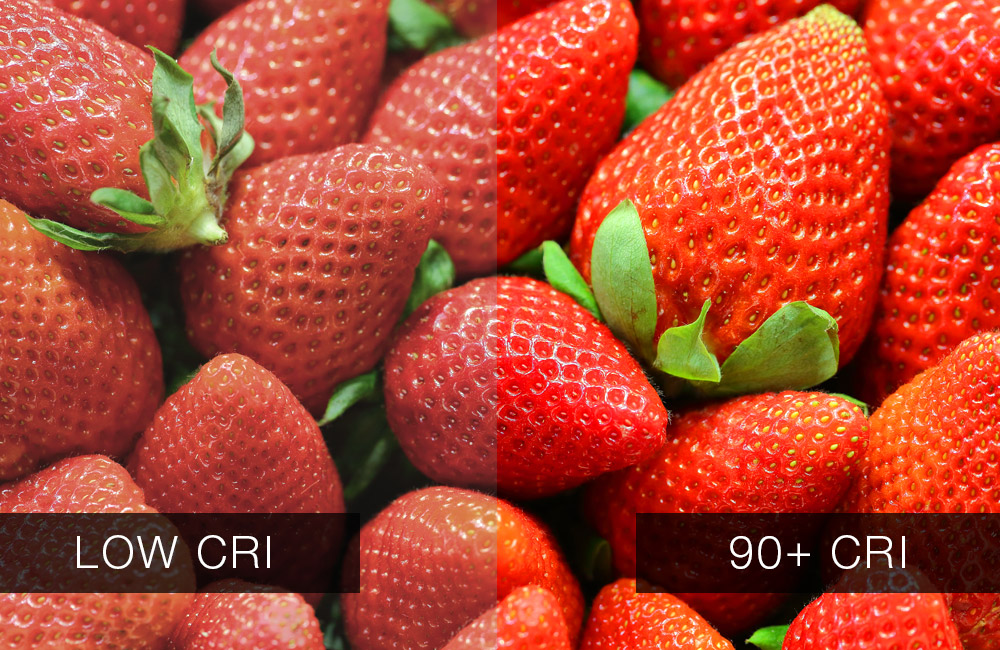
Developed well over 50 years ago, Color Rendering Index (CRI) measures the ability of a light source to reveal the colors of various objects in comparison to the ideal (daylight) source. In other words, how similar an electronic light source (like an LED luminaire) renders colors compared to natural light.

CRI indexes eight standard colors and how these are represented by a specific light source compared to natural daylight. 100 is the optimal ‘best’ score. The average CRI for modern LED lighting is between 80 – 90, and are considered a “good” color representation, relatively true to nature.
Why a New Metric?
Well, since around 1974 the method for measuring color rendering has been largely unchanged – unlike the advancement of lighting and technology. With LED lighting now so common, lighting designers and scientists strongly feel CRI is becoming less effective at achieving desired results in the real world. While many lighting professionals will continue to work with CRI, TM-30, developed in 2015 by the Illumination Engineering Society (IES), provides an alternative, more comprehensive color index. 
What’s the Difference Between CRI and TM-30?
CRI has some limitations:
- Only eight color samples are tested for CRI.
- CRI only uses color fidelity to base its index score, ignoring other spectral values.
- When comparing CRI values, Correlated Color Temperature (CCT) must be identical.
- Two separate light sources with the same CRI score can render colors very differently.
- A high CRI measured rating could produce or represent a low TM-30 score.
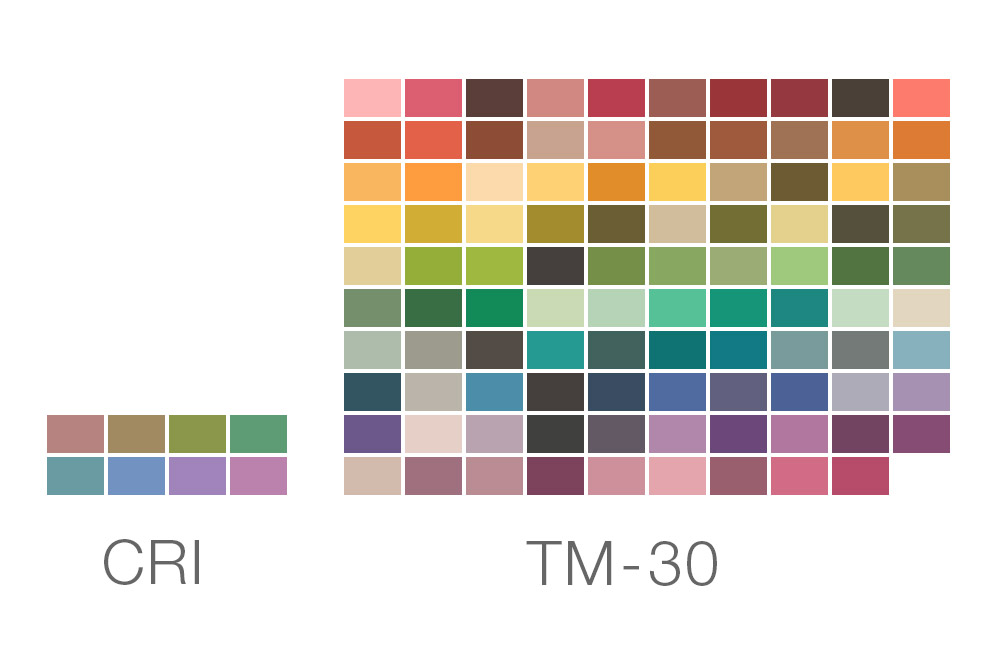
CRI measures just 8 color samples. TM-30 uses 99 color samples – quite a difference! The use of 99 color samples versus just eight allows for a more statistically representative and reliable metric.
CRI is measured using a light fidelity metric ONLY. The TM-30 rendering index uses a more comprehensive range of three color metrics:
- Color Fidelity (Rf – “same-ness” index)
- Color Gamut (Rg – saturation index)
- Gamut Shape (visual description on hue and saturation)
Color Fidelity: Enumerates the accuracy with which the color appearance of surfaces and objects under a given test source match their appearance under a reference illuminant.
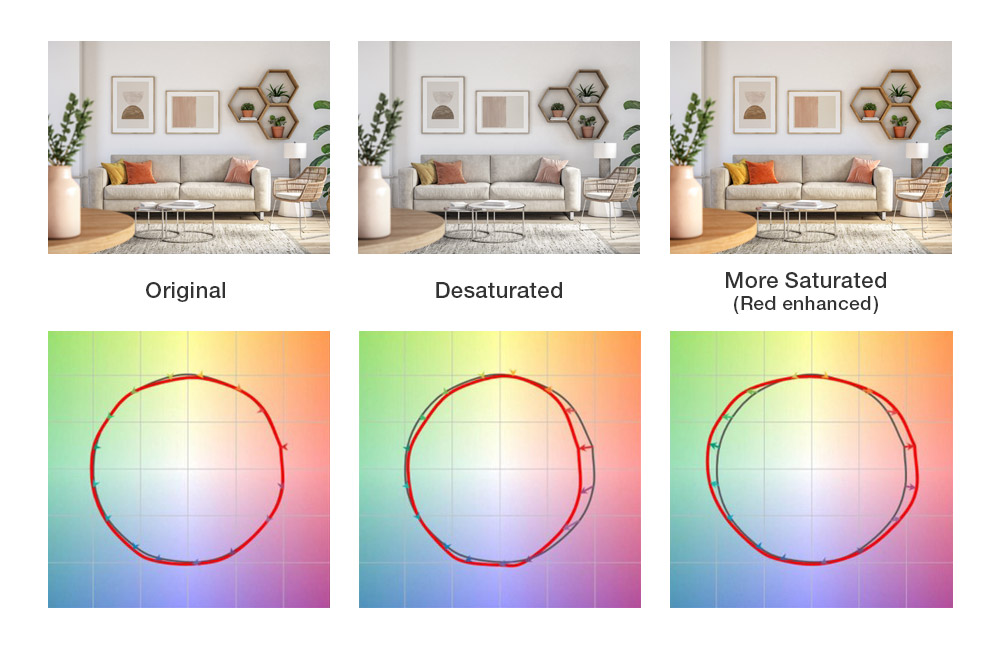
Color Gamut: Enumerates the average increase or decrease of the chroma of surfaces and objects when viewed under a given test source relative to when viewed under a reference illuminant. As an example, an Rg value below 100 indicates that, on average, the light source renders colors as less saturated than the reference source, and an Rg value above 100 indicates that, on average, the light source renders colors as more saturated than the reference source.
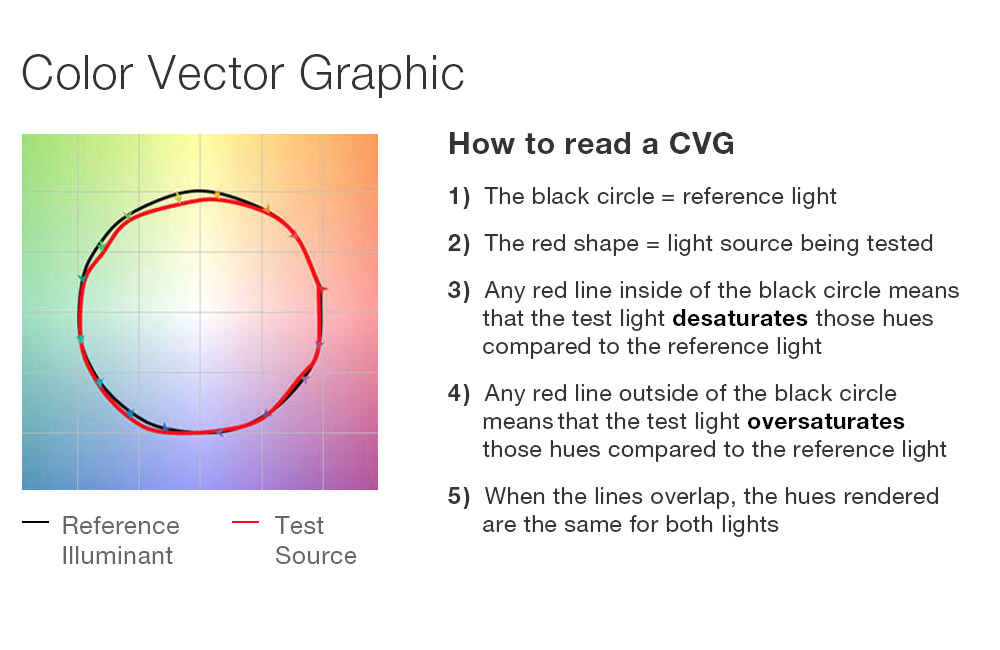
Color Vector Graphic: Provides a visual representation of hue and saturation changes occurring in surfaces and objects when viewed under a given test source relative to when viewed under a reference illuminant. The addition of the Color Vector Graphic provides a wealth of color rendering information beyond averages, showing us at a glance exactly where the hue and saturation shifts are taking place on the color spectrum.

A Better Way to Measure Color Accuracy
With TM-30, a light source can be measured using both fidelity and gamut, together these provide the preferred or intended outcome for many designers and those considering lighting for specific areas.
The advantages of TM-30 really come into play when representing specific items or products – say, in a retail or fashion environment. A CRI score might be high, but that doesn’t mean it’s ideally suited for certain colors, in certain environments, or for the desired look & feel. This is where a vector graphic helps a user choose the right lighting for a given situation based on the colors they wish to accentuate.

While there’s no single “best” TM-30 score, you’d see near-perfect overlapping on a color vector graphic – ideal when you need to mimic natural sunlight.
The Future of Color Rendition – the Standard?
TM-30 was introduced with the intention to provide a new way of measuring light fidelity and help users analyze the color characteristics of both modern and traditional solid-state light sources. This brings greater fairness and accuracy of the measurement.
As an improved and more comprehensive color metric, we can see its value for those who need more accurate detail to measure the color representation of several light sources.
With CRI, it seemed simple, a higher CRI score = better, more accurate color representation for a given light source. However, TM-30 provides users/designers with more information, critical to making informed decisions for the optimal light source.
At DMF, we continue to explore TM-30 results as a tool to develop new sources, further increasing options for both designers and end users, and can provide TM-30 results for any product upon request.
Focused on innovative quality – we continue to turn decades of R&D performance into the elegant luminaries of the future.
Learn more about TM-30:
Department of Energy FAQs
– – – – – – – –
Connect on LinkedIn, Instagram, Facebook, or Twitter to stay up to date with everything that’s happening at DMF Lighting.
As a critical infrastructure, it’s essential that construction sites receive products on time. That’s why we’re continuing to ship and receive during the COVID-19 crisis, while of course following established guidelines regarding contact free deliveries, regularly disinfecting and social distancing to ensure the health and safety of our customers and employees.
We know how to deliver
Contractors, distributors and specifiers depend on the availability, speed and delivery accuracy of our products. Our strategically positioned Southern California warehouse is assembling, stocking and shipping as usual. Even during these uncertain times, most standard orders received before noon go out that same day.
As always, our team is available via email and phone to assist with orders, inventory and lead times.
Please do not hesitate to contact us with any questions.
– – – – – – – –
Connect on LinkedIn, Instagram, Facebook, or Twitter to stay up to date with everything that’s happening at DMF Lighting.
Due to their unique usage, closets and storage spaces demand special electrical code requirements
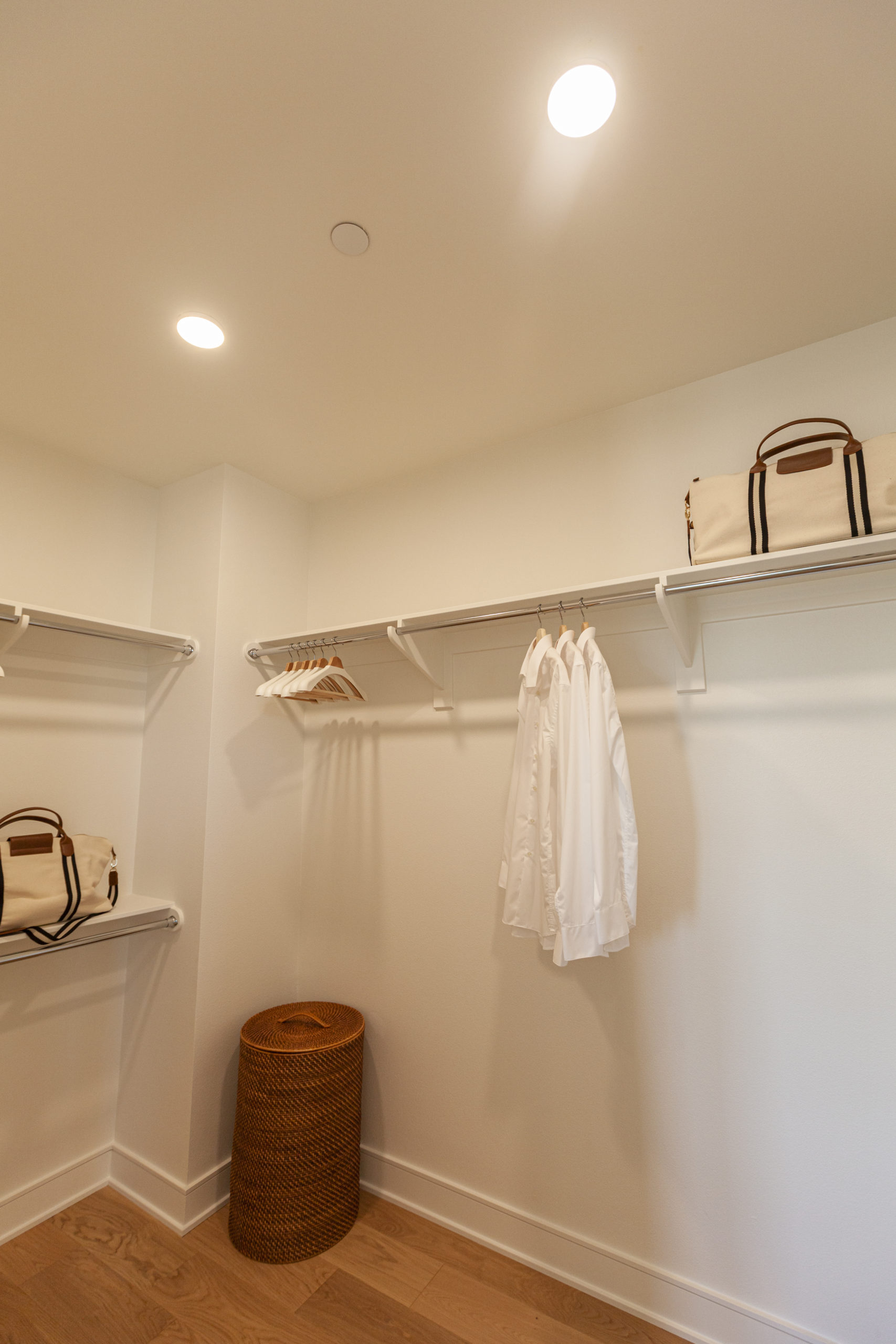
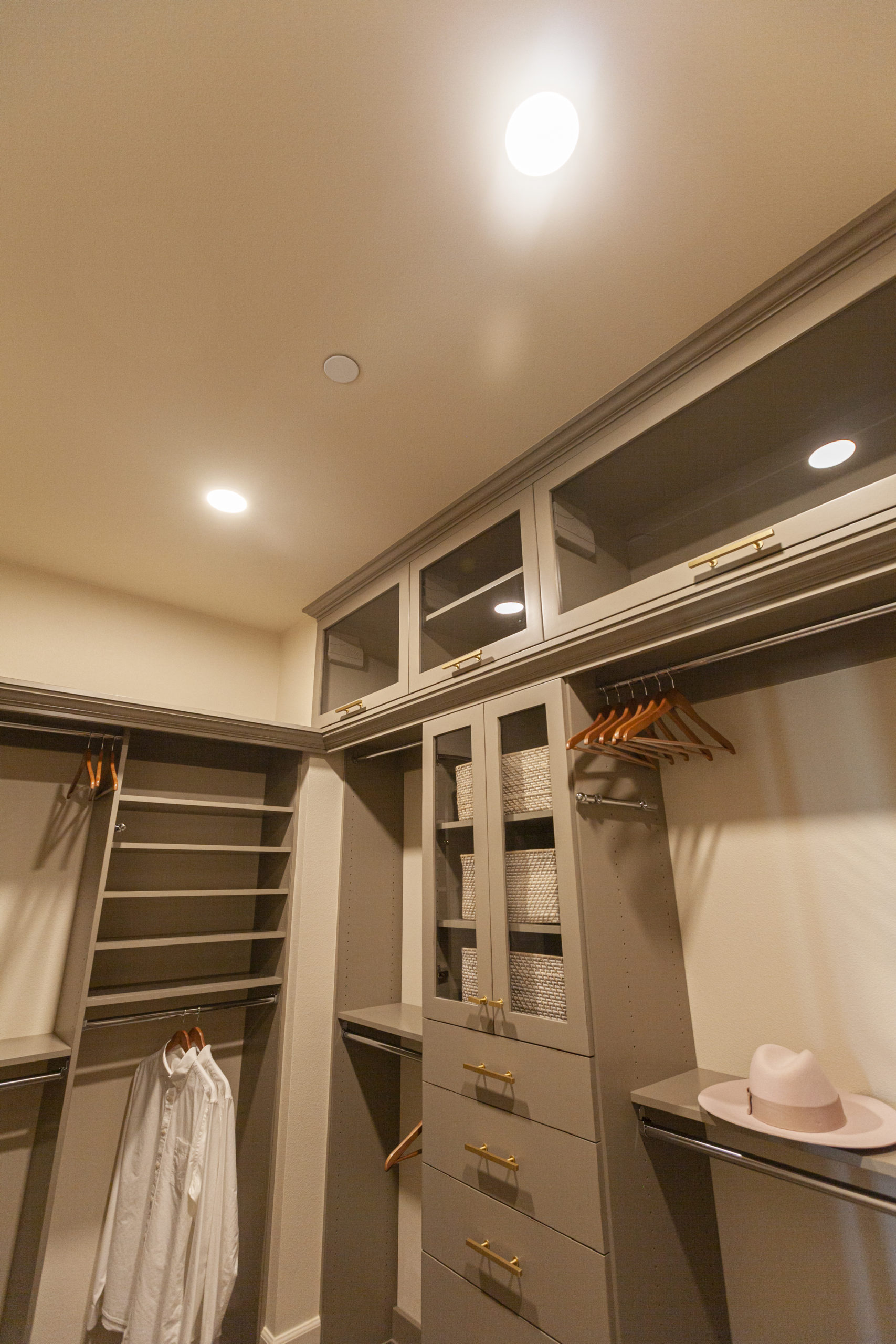
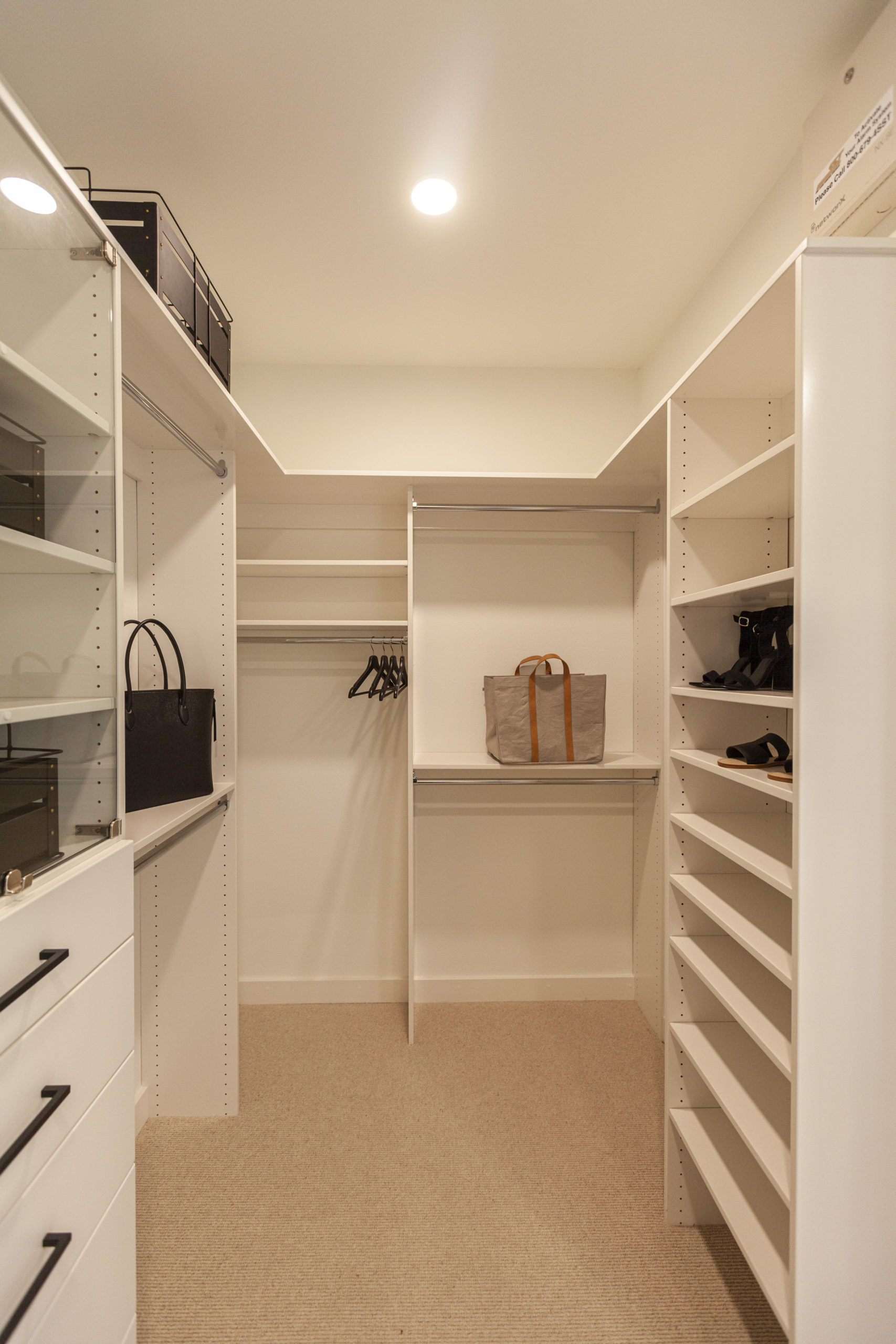
Whether building a new walk-in closet or renovating an existing storage space, the choice of lights is important. Light fixtures in any small closet can add safety, convenience and even aesthetics. While lighting is not required by the National Electrical Code (NEC), it does contain specific mandates for the types of light fixtures as well as minimum clearance space allowed in closets.
NEC Requirements for Closets and Small Storage Spaces
As outlined in Section 410.16 of the NEC (NFPA 70-2017), luminaries in clothes closets must be:
(1) Surface-mounted or recessed incandescent or LED luminaires with completely enclosed light sources
(2) Surface-mounted or recessed fluorescent luminaires
(3) Surface-mounted fluorescent or LED luminaires identified as suitable for installation within the close storage space
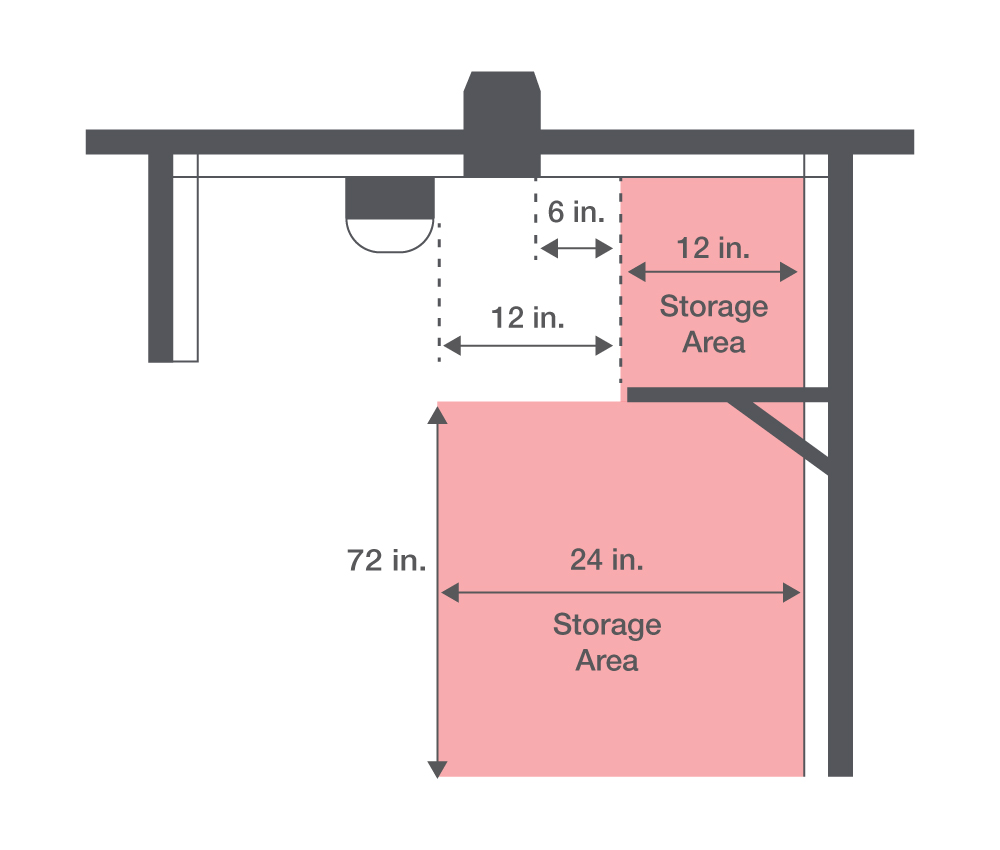
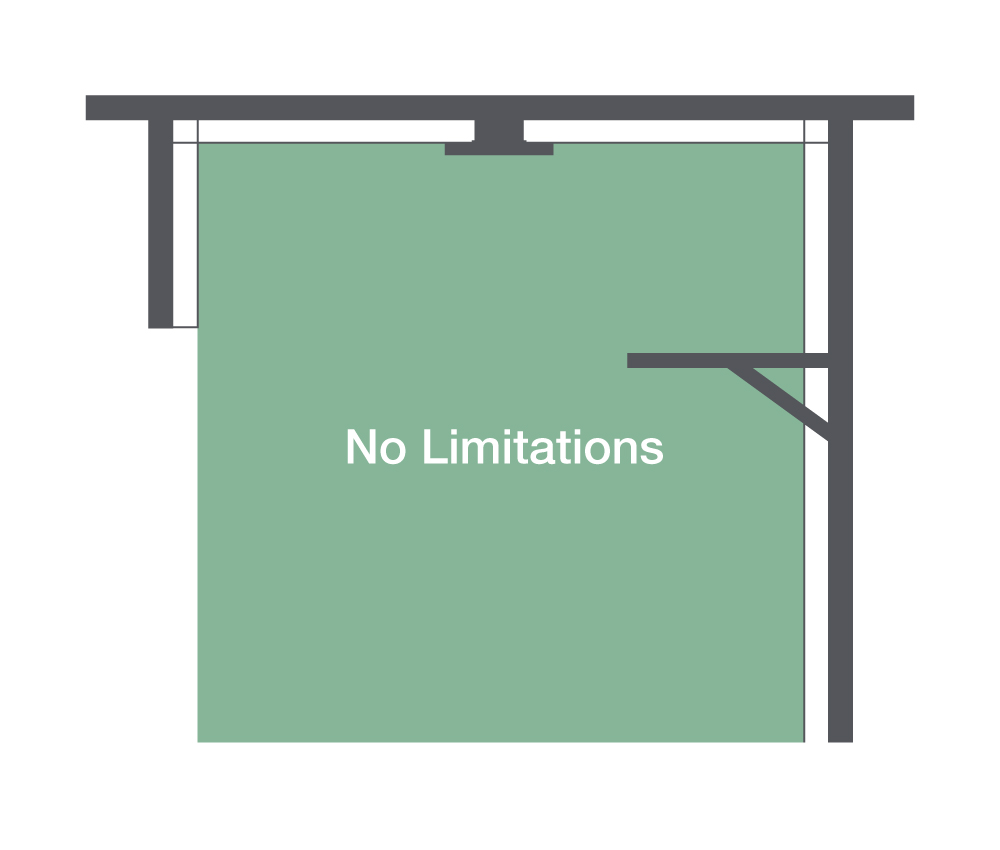
In addition, permitted luminaire types must also meet minimum clearance requirements. Depending on the lighting type, the space between the fixture and closet contents requires up to 12″ of clearance. But what if you don’t have the necessary space?

S Series Surface Mount LED: Closet Ready
Available in Round or Square, the S Series Surface Mount LED is rated for installation within a clothes closet storage space. So no matter the clearance, the 750 lm can be utilized, even in direct contact with closet contents.
This product complies with NEC Section 410.16.A3 and C5.

DMF engineers conduct rigorous thermal testings to ensure the safety of our products. The S Series underwent further third party testing, where it passed the United States UL Closet Rating Test. And like all of our lights, we back the S Series with a five year, 50,000 hour guarantee for even more confidence and peace of mind.


Learn more about the S Series Surface Mount LED
Stay connected with live, personalized training sessions
In an effort to stay connected while practicing social distancing, DMF will now host customizable webinars. We invite you to schedule your webinar – you choose the product, date, duration, and we deliver.
If you would like to get something on the books, please email training@dmflighting.com.
Or visit the Training section on our Resources Page to schedule a custom webinar and we’ll do the rest.
We look forward to connecting with you!
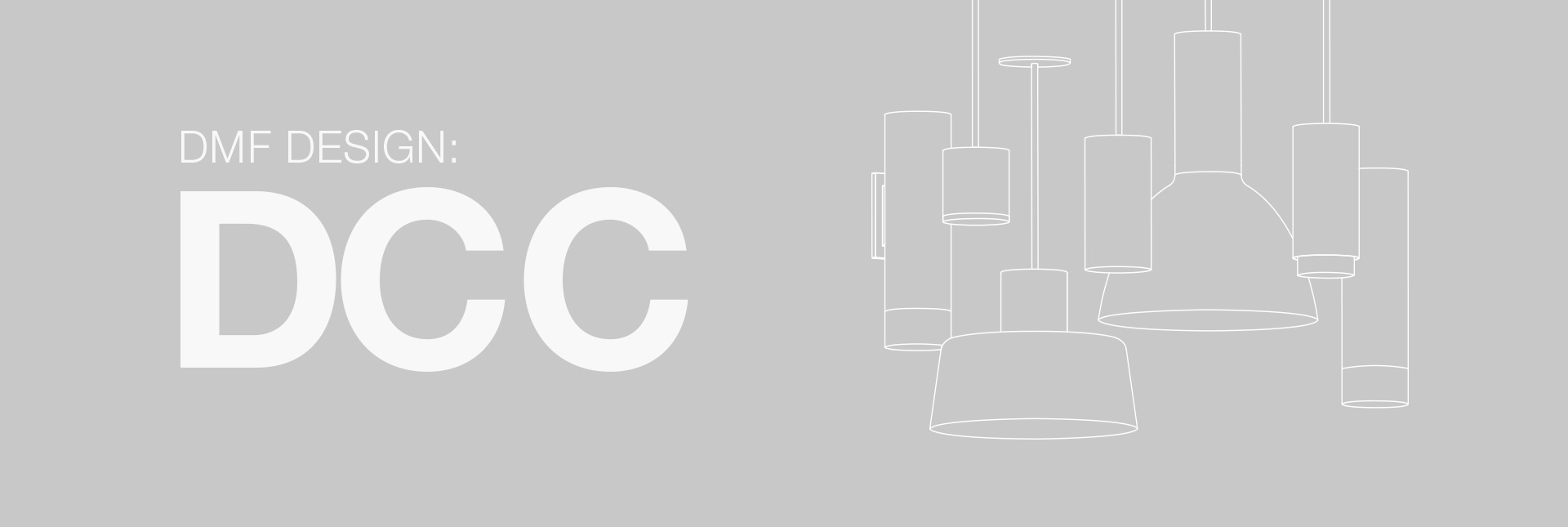
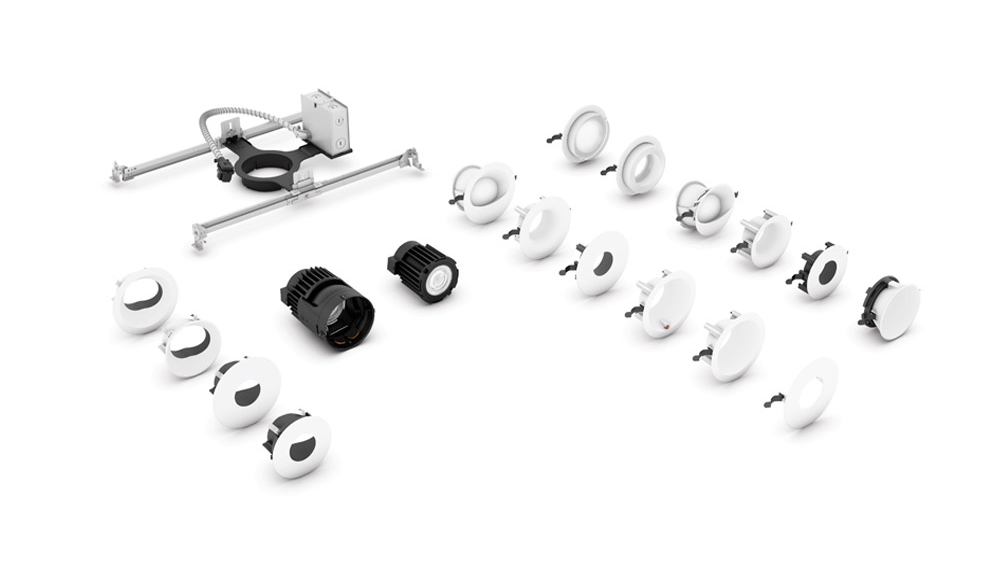
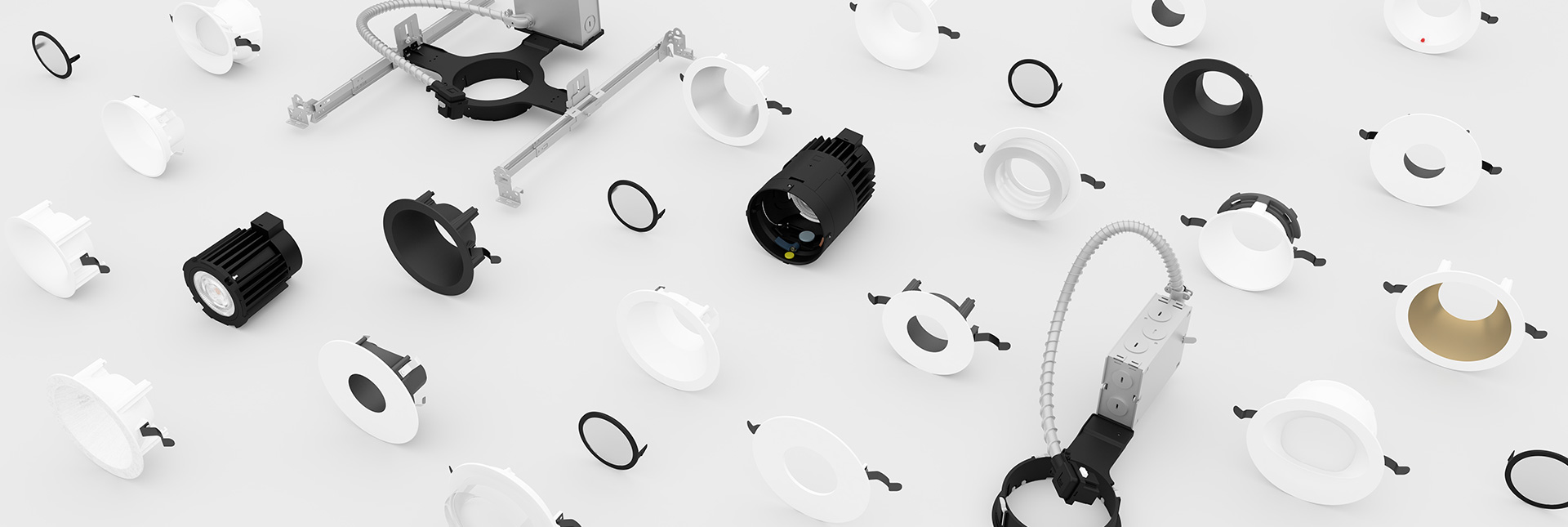
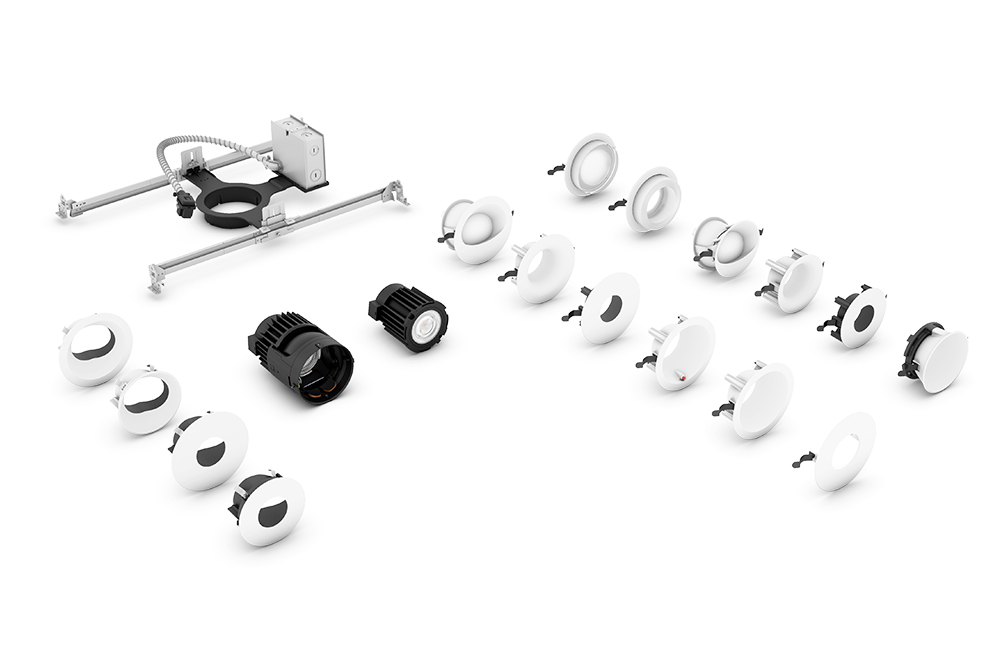
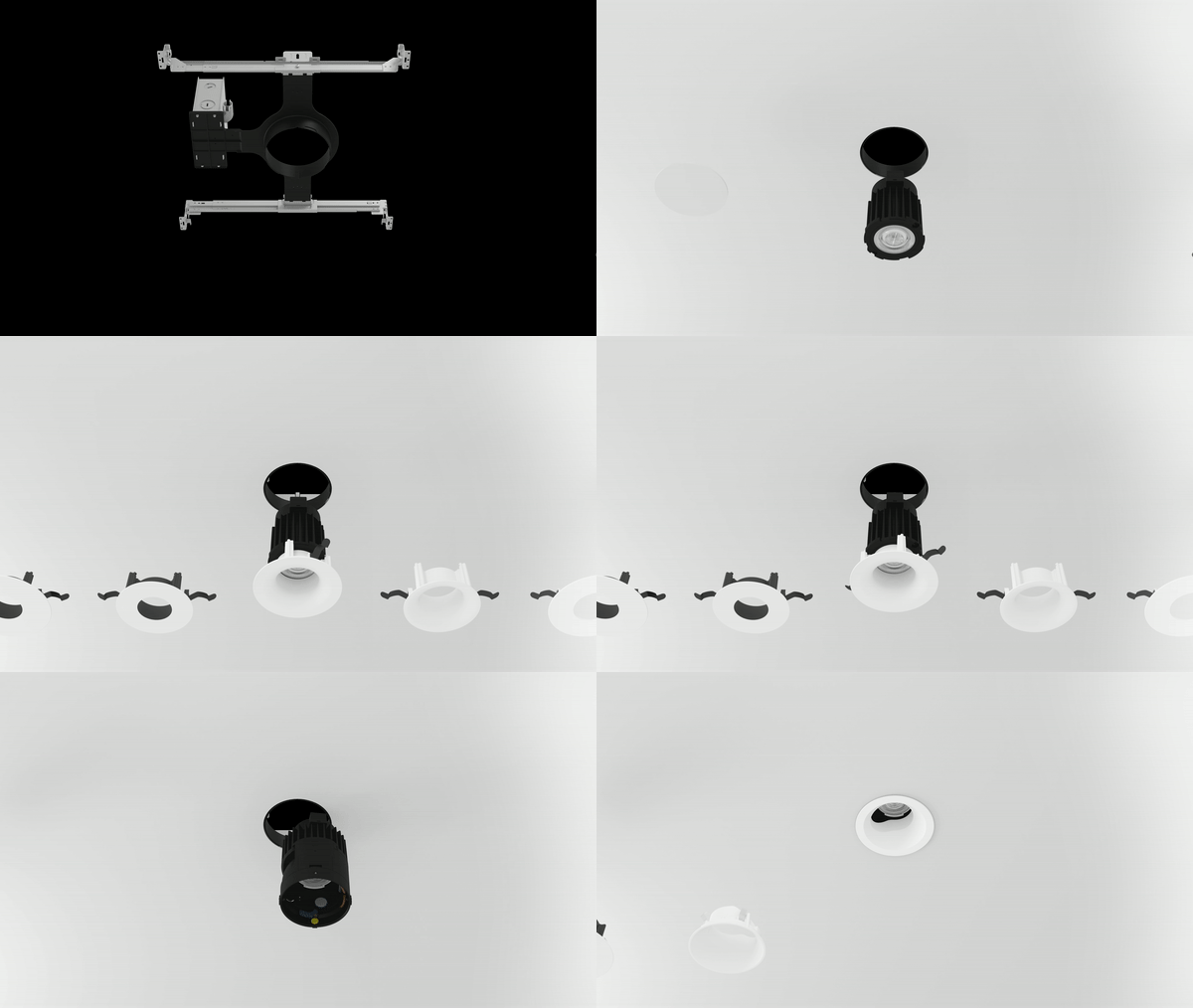
DMF is proud to introduce the next evolution in downlighting with its updated DCC series. Including an uplight feature, new shades and trims, and a range of other options, the DCC series is reconfigurable to over one million variations. It centers on a modular system, so it’s exceptionally easy to specify, install and maintain. To learn more about the product and its features, we spoke with the DMF design team.
Walk us through how the new version of the DCC got started.
The first version of the DCC didn’t have much product variation. We did have some options, but it was more functional than aesthetic. So, the project that we are now launching with the shades and the snoot and a shorter version of the trim, that was to diversify the shape and functionality of the fixture.
People wanted functional light that could also be decorative too. So, we figured we have a great platform with the DCC, and we have this twist and lock feature that really gives us the capability to add pretty much whatever we want. How can we use this feature to add more design elements to our fixtures?
That’s where we came up with adding another decorative trim, and some shades to diversify the shape of the cylinder. You can focus light down or you can add different elements to a space from the suspended fixture or surface mounted fixture. We added the snoot because that’s going to help cut down on glare, and a hyperbolic trim, which makes a really cool effect as the light drops off of the surface.
And why did you add the uplight?
We did the uplight because we wanted to be able to add indirect light from our pendant. By adding another light source, you can increase the amount of light in a room as it’s going to be reflected back down to the surface. You are going to get more light back down without any increased glare. So your downlight is still going to be, for example, maybe 600 lumens down, but then your uplight can help you get to maybe 1,000 lumens.
So you see the uplight feature as expanding the applications of the DCC?
Yes. We spoke with a lighting designer and asked where would you put a pendant with an uplight. And he said, “all over the place.” People are focused, now, on more comfortable lighting. People are tired of getting blasted by blue LEDs, and they are much more willing to invest in an indirect light they know is going to make the people in their space much more comfortable. Having efficient light fixtures and more comfortable ways of lighting a space using indirect lighting is definitely the future. So, this uplight was just seeing the demand in the marketplace. Many people offer an uplight, but you don’t see as much diversity with accessories around this type of unit.
What was the goal of the new DCC series in the market?
More options: both in a decorative way, but also in a functional way. It’s making sure that we have not just one point of differentiation, but a number of different points of differentiation that we can provide to our customer base. We wanted to be able to diversify the capabilities within the fixture. It was pretty diverse to begin with, but we wanted to continue to make the DCC as flexible as possible.
Are there specific needs that you tried to meet with this product?
Architects are really keen on what options you have. They want fixtures that are diverse, that are going to highlight the spaces that they’re creating. So, they want something that can basically make the architectural elements look good, and is affordable, is ready to ship immediately, that they can put their trust in, and it’s going to last for five-plus years.
Then, when we get contractors in, they don’t want their guys spending 25 minutes installing a light fixture. The DCC is incredibly easy to install. Maybe four or five minutes tops, and you have your light fixture installed.
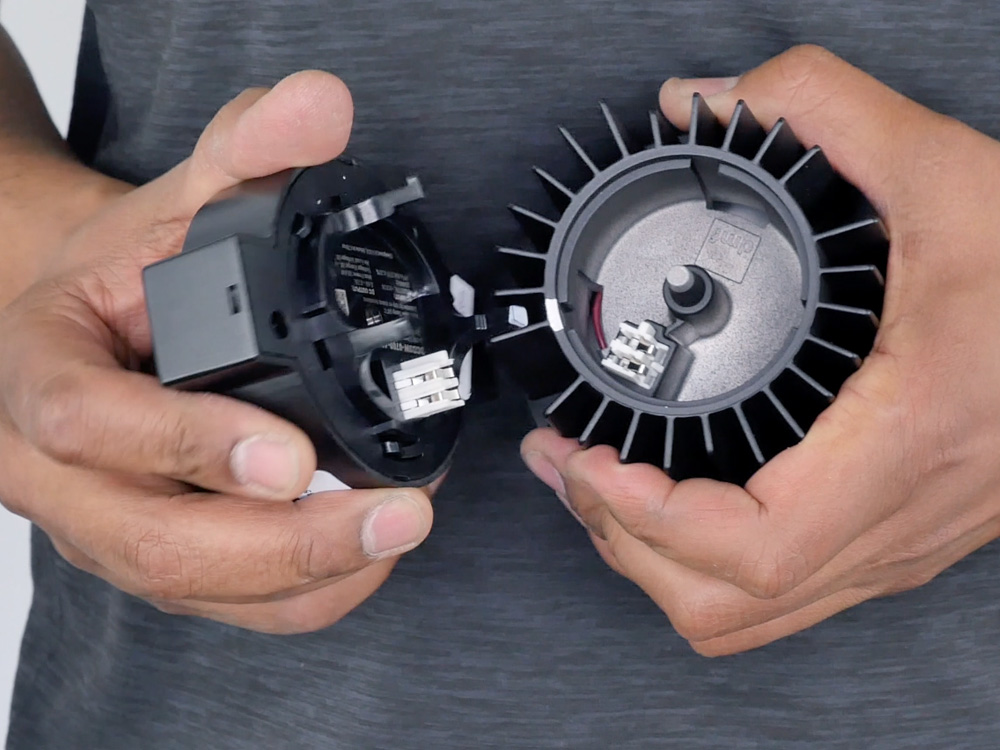
People in the hospitality industry come in and their concern is if a light is out in one of the bathrooms, say, in their hotel, they used to take that room out of service. So, by them understanding that it takes five minutes to take out a faulty unit and replace it with a good unit, they don’t have to wait for somebody to ship a new fixture, they don’t have to take out any drywall or anything. They can just replace a single unit within five minutes and they’re not taking a room out of commission for the night or more. This is something that people can stock easily in their maintenance rooms. So, there’s a number of ways to look at this product from a couple different points of view.
Has working with clients in different industries and different points in the chain of use taught you anything?
We always ask what could we do better, or what can we learn from another industry? When we went to the job site of one of the contractors we work with, and we saw how the speakers were installed to the joist on the project. And we thought, we can do that on our stuff. We can learn from other people. We don’t have to do everything the way they do it in lighting. We can take design elements or functional elements from other industries and implement it into what we do to make the installation process, or even the specification process, easier.
How does the customization process work with the DCC fixture?
For a lot of things we build it all custom and to order. So, we have to know how long do we need to make the cord? Do we need to send it out for a custom color sample? Do we need a warm-dim module or do you want just a regular module? Is it an adjustable or is it a downlight? It’s basically building that product and having the customer understand what they’re buying, and then making sure that it’s conveyed to us what they’re buying so when we ship the product, we’ve shipped them what they want and everyone’s going to be happy.
We know we’ve done a good job when we get returning customers. We get success stories a lot, and that comes down to designing products well that are going to work properly at their application. We’ve done all the testing, we’ve done all the qualifications, and there’s not going to be surprises. Sometimes we even do custom jobs for people, or a custom configuration with a certain power supply that they want or certain dimming system they have in their building and they know that we have the resources to do all the necessary testing. There’s a lot of value in that—having that on-hand expertise in-house. Honestly, what people look for is somebody that they can trust and they know they’ve given this project to DMF, and we’ve never let them down.
How is the DCC different from its competitors?
The differentiation comes back to our modular story, and our workhorse of a light engine. Also just the ease of use—how easy is it to change something out if you need to. How easy it is to build the product. We have an incredible support team should something go wrong, and we have product availability. So, if you find that you forgot the lights over the bar, you can call us and we can have it out the door in five days. We have really well-built fixtures that last a long time. The quality that we put into creating the products is a big selling point and why we retain the customers that we have. That kind of goes into the electronics too.
Can you speak more about the light engine?
We build our power supplies custom to the light fixtures that we’re designing. And how long the product lasts is going to come down to how well the electronics are on the inside. How well the driver is built. We build them in-house with our own engineering team, and so this driver is built to the specs of this module.
What are the unique features of the DCC?
The flexibility. That’s what we pushed big time—super flexible, easy to use. Put it anywhere by making a minor change, and it’s still pretty easy to use, especially with the twist-and-lock system. So, its uniqueness would be mechanical but also functionality.
What accomplishment(s) are you most proud of on the DCC?
That we were able to take a very streamlined product, offer more variations that can benefit a space, but also keep our core story the same. You know, modularity, ease of use, ease of configuration. Basically, expanding on something that was already great to make it even better.
How would you describe DMF and its core philosophy?
The ethos of the company is to take something that’s existing and make it better. DMF is taking that to another level with LED: making our own fixtures for universal housings that would perform better than—or similarly, and at a lower cost price point—than the competitor’s.
What makes DMF’s products unique?
We design our products for ease. Everyone finds that the products are really easy to work with—whether it be the specifier, or whether it’s the person doing maintenance. Everything is integrated into the module. So when something has to change, all you have to do is take out the module and the whole unit can be switched out really easily. That’s really good for maintenance, but it’s also good for a lighting designer.
We also focus on design a lot when developing products. The fixture looks good when it’s off, but also when it’s on—the light output is beautiful. The electronics are going to last: it’s not going to overheat, it’s going to meet all the code requirements, and it’s going to function well. It’s going to do everything really well.
Learn more about the DCC Cylinder.
_ _ _ _ _ _
Stay up to date with everything that’s happening at DMF: LinkedIn, Instagram and Twitter, Facebook
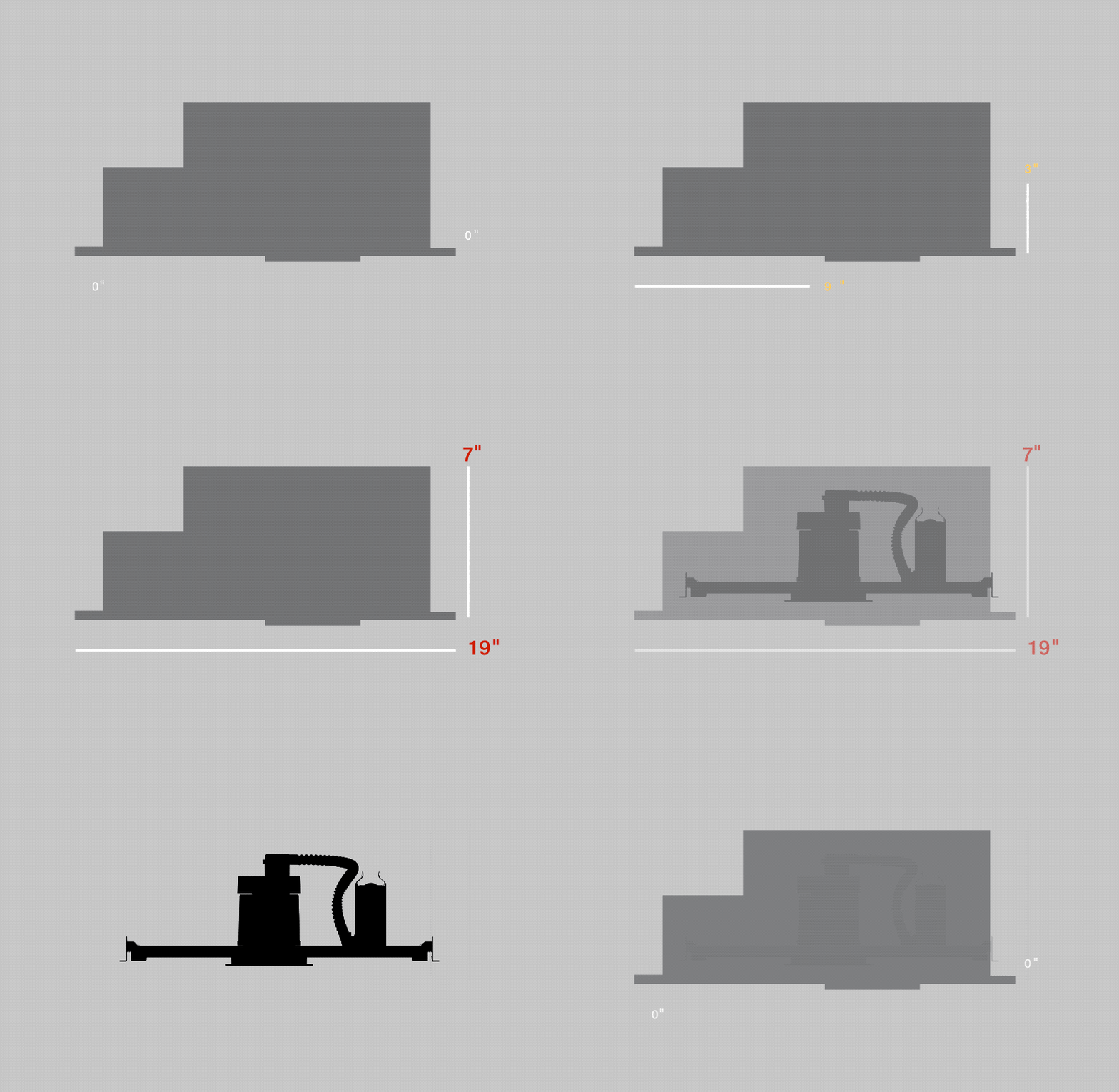
Traditional commercial housings use a big, heavy black box to control light leaks. Measuring as much as 19″ long and 7″ tall, the bulky housings severely limit spacing options for lighting layouts and designs. Heavy boxes are also more costly to ship and more cumbersome during installation.

DMF Lighting revolutionized the commercial industry by decreasing the size and weight of the housing, allowing for more lighting layout options while also making it easier to install.

Smaller is better
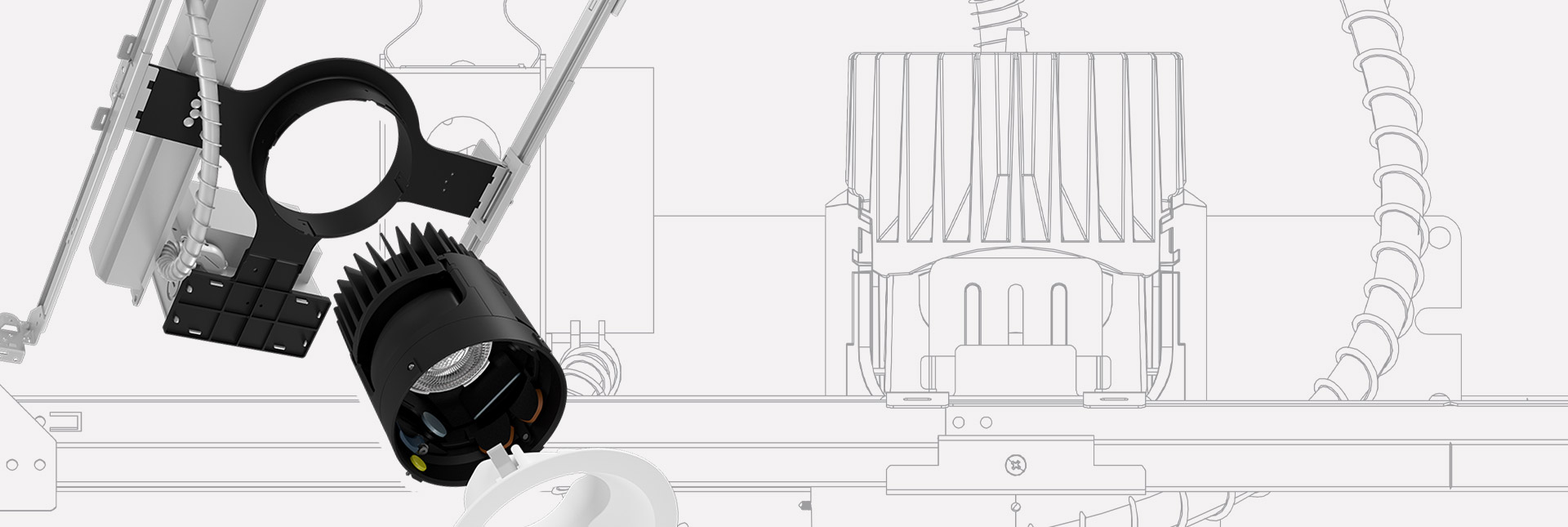
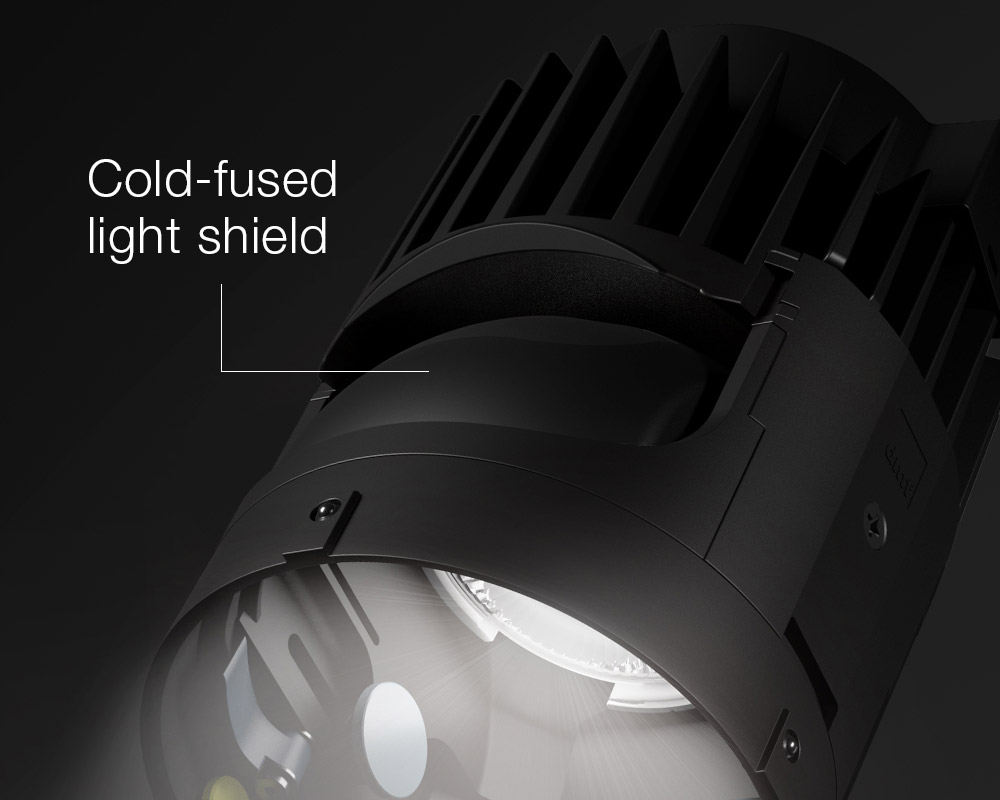
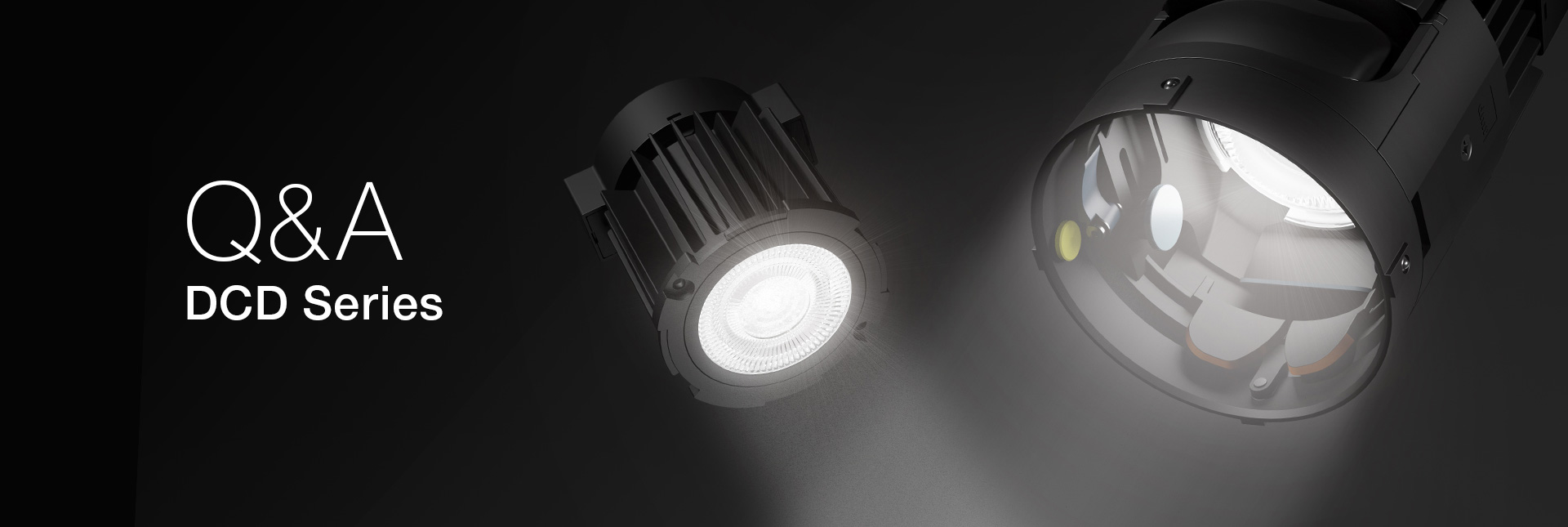
Instead of a large box over the entire housing, the Adjustable DCD4 features a module mounted light shield to eliminate light leak. Far smaller and far lighter, the cold-fused shield takes up a fraction of the volume of a traditional can. The smaller size makes it more manageable to handle during installation. The lighter weight means reduced risk of sag.
The smaller size makes installation easier and helps prevent fixture movement below the ceiling.

Sturdy as ever
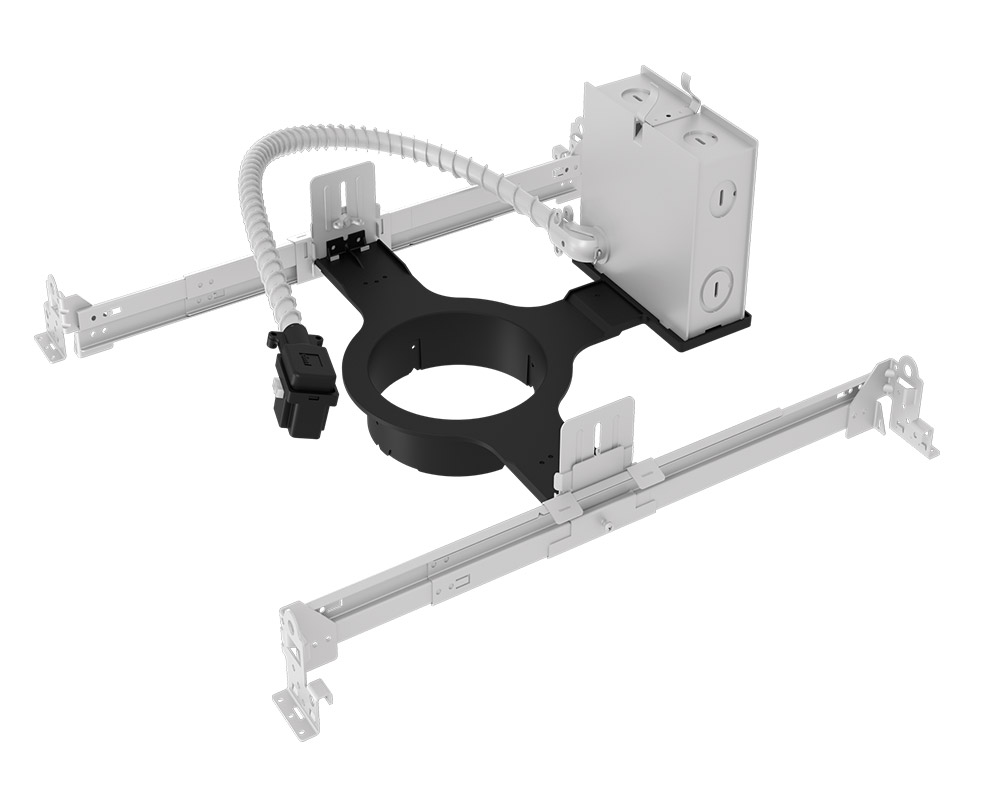
The DCD Series Housing is not only small, but strong as well. A stable housing makes sure adjustable module movements stay perfect. Specially-engineered, galvanized-steel bar hangers ensure the complete luminaire acts as a perfect single unit.

With a smaller housing that doesn’t sacrifice performance, the DCD Housings install quickly and ensure the aim stays steady.
Learn more about the DCD Series

– – – – – – – –
Connect on LinkedIn, Instagram, Facebook, or Twitter to stay up to date with everything that’s happening at DMF Lighting.
DMF understands that conditions on a project can change.

A new paint color or material can have drastic effects on your lighting. So if you can’t decide on color temperature or illumination is not as expected, now you don’t have to worry. The DCD Series provides easily configurable, robust lighting capabilities, giving you the flexibility you need for ever changing lighting plans.

One housing, many choices
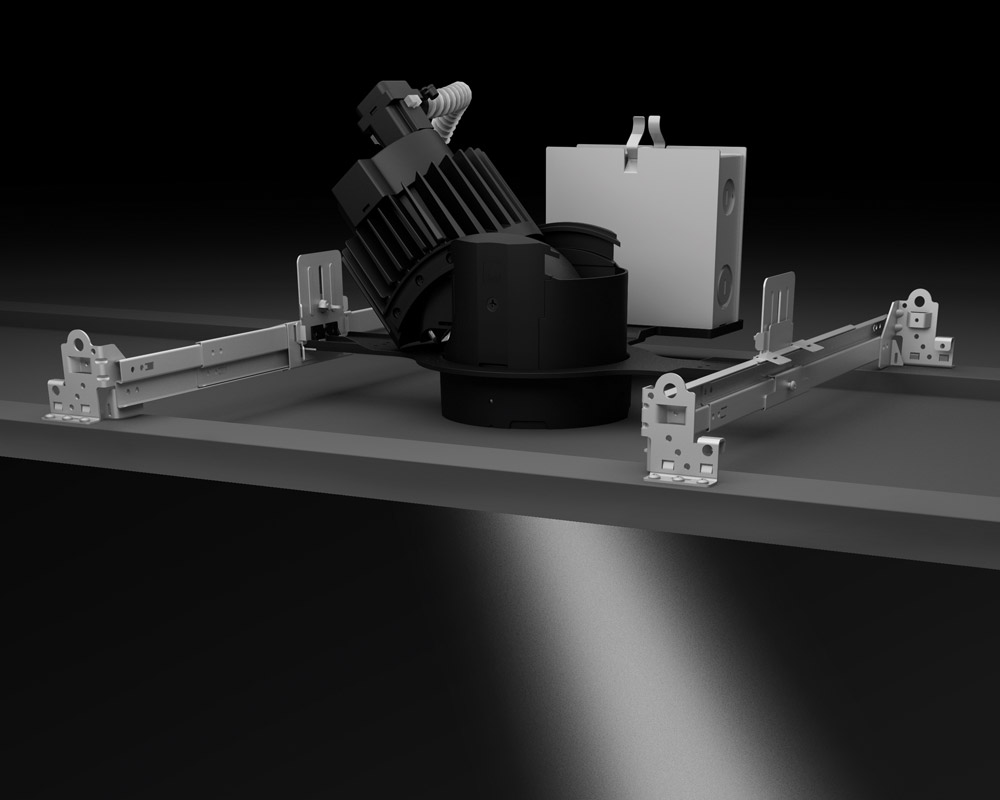
The key innovation for the DCD Series is its modularity. A single DCD housing can tackle your whole project with a wide range of options that you can change without the need for above ceiling access.
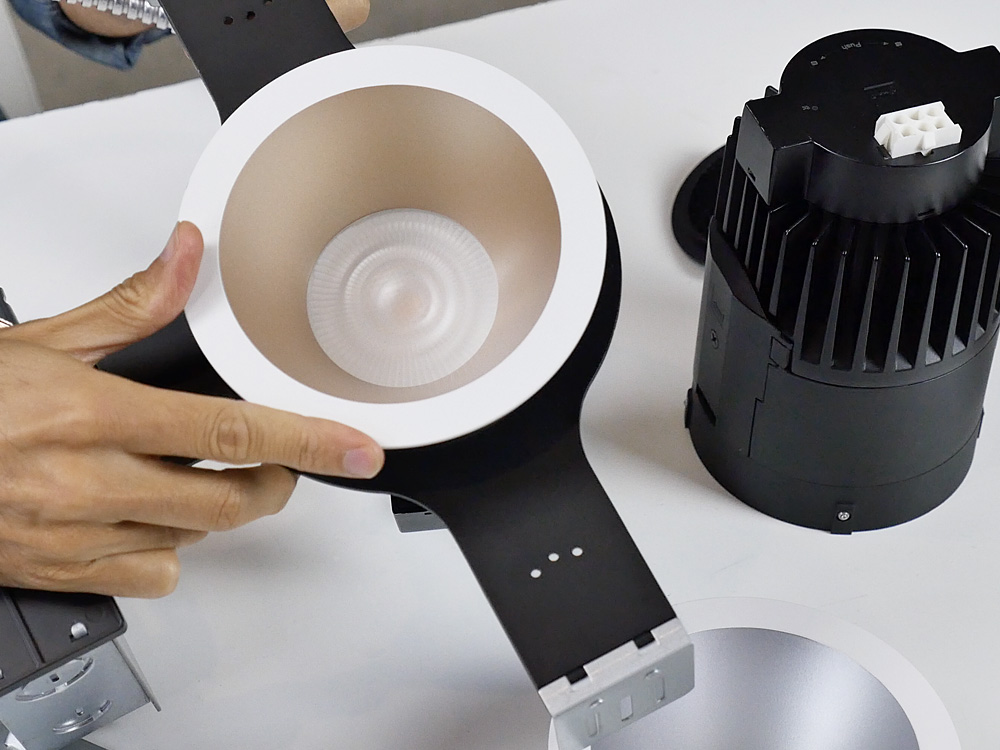
Start with the housing. Later, you can decide on the type of lighting, beam angle, lumen output, color temperature and more. Then should plans change, you can easily swap optics or add specialty lens options without touching the housing.

Need even more radical lighting changes? Alter color temperatures, lumen output or switch between downlight or adjustable using the same housing even after the ceiling is installed. The DCD Series makes it all simple with precision-crafted, inter-operable components.
“We have a single housing that works with any type of application you want, and if you change your mind later on, our product can support it.”
The DCD Series is flexible enough to illuminate your whole project with a broad range of light and aesthetics options, all with just one housing. Pair your light with a beautifully finished trim and create exactly the results you’re looking for.

The Future of Downlighting
The DCD Series is a higher-lumen, interoperable downlighting solution that radically simplifies configuration in the field, bringing together robust lighting capability and a highly modular system. It’s a revolutionary new downlight that provides superior lighting quality, more control, and more options.
– – – – – – – –
Connect on LinkedIn, Instagram, Facebook, or Twitter to stay up to date with everything that’s happening at DMF Lighting.
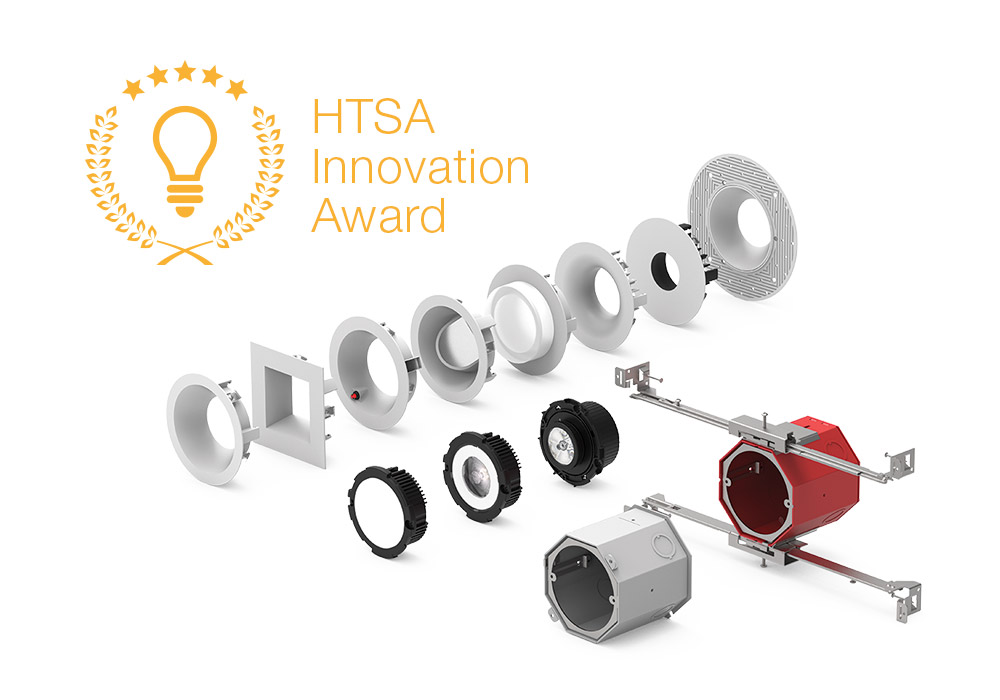
DMF’s OneFrame System continues to rack up accolades, this time from outside the lighting community.

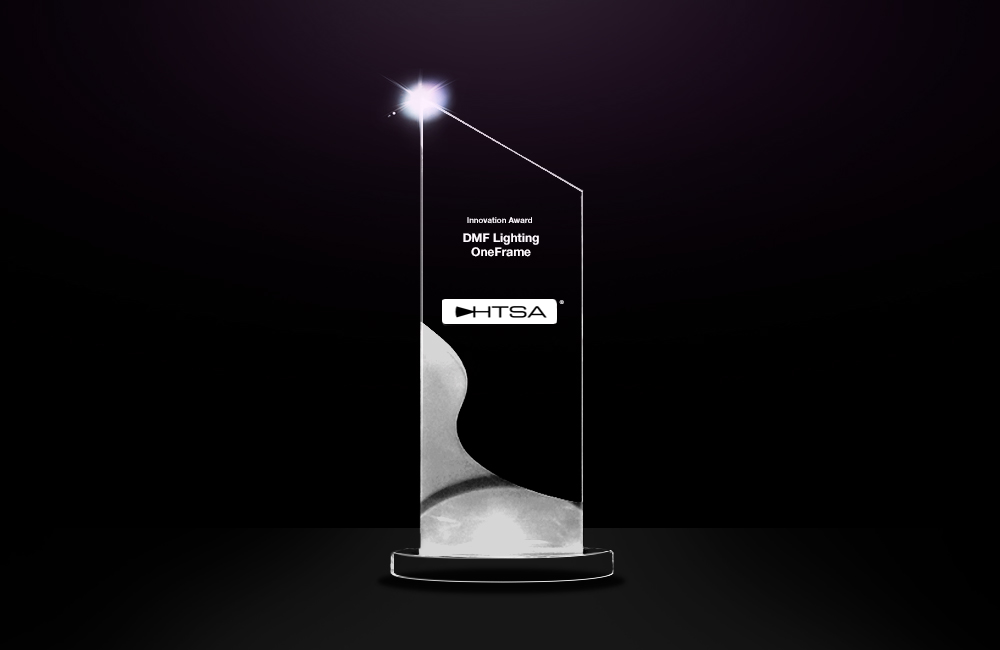
The HTSA (Home Technology Specialists of America) recently recognized the OneFrame with its Innovation Award for its amazingly small footprint and game changing versatility.
As a lighting company, we’re proud to have one of our products recognized by the AV industry as it truly showcases how simple our products are to use. The award also illustrates just how critical lighting has become to your home technology systems.

Perfect Balance
Of course, displays and speakers still stand as the two most critical items in an audio visual system (it’s in the name after all!), but lighting should not be overlooked. From 1% dimming levels to system integration, lighting plays a major role in AV.

The perfect balance of functionality and ambiance is critical for home theater lighting. Over lit spaces and unwanted ambient light can ruin the viewing experience, while poor lighting layouts can have you tripping in the dark. Whether it’s light fixtures or natural lighting, the ability to manage all light sources is critical in AV.
A system of fixtures, controls and window treatments that manages light while communicating with each other.
In order to manage light, you need a complete lighting solution. Window treatments to eliminate unwanted lighting. Controls to communicate with devices. And of course, high-performance LED fixtures that enhance the appearance of the room.
Quality of Light
Controlling light goes far beyond turning it on and off. Directional lighting and beam control work together to place light exactly where you want it. In addition, CRI, color temperature and dimming performance play critical roles in light quality. DMF recognizes these factors and is committed to engineering LED downlights that incorporate all of them into simple, highly compatible downlights.

Learn More About: HTSA
Learn More About: OneFrame System
– – – – – – – –
Connect on LinkedIn, Instagram, Facebook, or Twitter to stay up to date with everything that’s happening at DMF Lighting.
Thank you to Power Design for letting DMF Lighting be a partner at Super Summit, a 3-day event full of engaging workshops, leadership development, food, and action!
DMF even got in on some of the games with our own unique twist on cornhole. Instead of traditional bean bags, we played with DRD2s to demonstrate its incredible impact resistance. The module survived over 100 tosses and still worked!
PDI Super Summit


We look forward to future events and partnerships! Congratulations again to Power Design on a successful first event!
Learn more about Power Designs Here
– – – – – – – –
Connect on LinkedIn, Instagram, Facebook, or Twitter to stay up to date with everything that’s happening at DMF Lighting.